
Imagine a bowl of food — an actual bowl, prepared by someone’s hands, carrying seeds that traveled here from somewhere else. Grown in soil that has known love and work — provision and harvest — longer than this city has had a name. As Executive Director of Food to Power and a Community Curator for this exhibit, I am not a neutral observer of the history I’ve learned. I live inside it. The people who have shaped my practice — and those I have had the privilege of shaping — are part of that history too. We grow together. Every Tuesday the door opens and no one pays. On Fridays, the food travels to those who cannot travel to it. I am writing this within walking distance of that farm, in a neighborhood the official data calls a “food desert.” Deserts are not an accident. They are natural ecological environments, and they sustained Indigenous people for generations before colonization ever touched this land. In this region, who eats and who goes hungry has never been accidental — it is the result of deliberate choices, policies, and power.
Food environments, ecosystems, and culture in the Pikes Peak region cannot be understood apart from the land itself — its altitude, its aridity, its demanding beauty — and apart from the Black, Indigenous, and People of Color communities with the deepest roots in it. Those relationships have too often been erased from the dominant narrative and the historical record. Patty Krawec’s Becoming Kin grounds us in this truth, asking us to understand land not as property but as a living being, deserving of a reciprocal relationship. Roxanne Dunbar-Ortiz’s Not a Nation of Immigrants dismantles the settler mythology that treats Indigenous and Black people as latecomers to a landscape that was, in fact, theirs first. Both books ask us to do something harder than learning new facts. They ask us to see differently.
Before there was Colorado Springs, the Apache, Arapaho, Comanche, Cheyenne, and Ute — and many other nations — were here. The Ute call themselves Nuche, a person of substance, of meaning, of soul. Pause here, and let that land. The Ute’s relationship with this specific area was comprehensive and ecological: men hunted deer, elk, and bison; women gathered berries, piñon nuts, and roots in woven baskets, rotating gathering sites carefully, never taking more than the land could replenish. The spring waters in Manitou are sacred. So is Garden of the Gods. Grinding stones found near Garden of the Gods document generations of food preparation. The scarred ponderosa pines — whose inner bark the Ute harvested for nutrition and medicine — are their own record. The trees keep history even when no one writes it down.
The Ute carried their plant vocabulary — specific words for specific uses, specific knowledge of this specific land — through oral tradition, through family, through the land itself. Forced relocation did not erase that. But it interrupted it. What that interruption cost has never been fully counted.
Nuevomexicano migrants from northern New Mexico brought something invaluable to an arid landscape: centuries of water knowledge. The acequia tradition — communal irrigation systems, governed by shared rules and collective responsibility — made farming possible in places that had almost no water system at all. Following that era came the sugar beet industry, which became Colorado’s most significant agricultural economy in the early twentieth century, built almost entirely on the labor of Chicano and Mexican families — the betabeleros. Men, women, and children bent over fields with short-handled tools for hours under the high-altitude sun, their children pulled from school during planting and harvest. The Arkansas River Valley — the same valley where E.D. Rucker,(Hillside hero) homesteads today in Penrose — was sugar beet country. The official celebrations of that era describe the industry as proof that settlers made the mountain desert bloom. They rarely name who actually did the blooming.
Under the Enlarged Homestead Act of 1909, Black families staked claims in the semi-arid southeastern corner of Colorado and built a community they called “The Dry.” Sisters Josephine and Lenora Rucker were among its founders. They grew roots into ground most people had written off as unworkable, and made it yield. History Colorado describes The Dry as a story of Black agricultural excellence — families who grew crops, preserved food, shared harvests, and built a community of self-sufficiency and dignity in defiance of Jim Crow. The women of The Dry considered a field, and bought it, worked it, and became the reason their community’s story exists.
In 1990, John Stokes Holley did something no official history of Colorado Springs had done: he looked directly at the Black community’s contributions to this region and wrote them down. The Invisible People of the Pikes Peak Region is not a corrective footnote to the dominant narrative. It is an indictment of it. Consider what that community built: the men who laid the track that made this city a destination; the domestic workers whose labor built the white households that built the institutions; the Brown Bombers, who won championships in a city whose restaurants would not serve them. Fannie Mae Duncan ran the Cotton Club on Colorado Avenue for decades — feeding, employing, and sheltering Black joy, and driving integration in a city practicing de facto segregation. When authorities told her to stop mixing races, she said she checked for age, not color. The sign in her window read “Everybody Welcome.” She meant every word. Chartered at Payne Chapel in 1918, the Colorado Springs NAACP became, by the 1930s, the sharpest organized resistance to redlining and segregation in the Pikes Peak region. These were not footnotes. They are the foundation. Candice McKnight runs the African-American Historical and Genealogical Society of Colorado Springs; for decades she has worked to ensure that the history of Black Colorado Springs — its people, its places, its genealogies — survives erasure by the dominant narrative. Rosemary Lytle Harris — journalist, NAACP president, and founder of Positive Impact Colorado — has spent decades making plain that energy justice, criminal justice, and civil rights are not separate causes. They grow from the same soil. Ron Stallworth, the first Black detective in the Colorado Springs Police Department’s history, understood that the freedom to thrive requires safety, and spent nine months inside the Ku Klux Klan proving that the city’s racial terror had a name, a membership card, and a presence at NORAD.
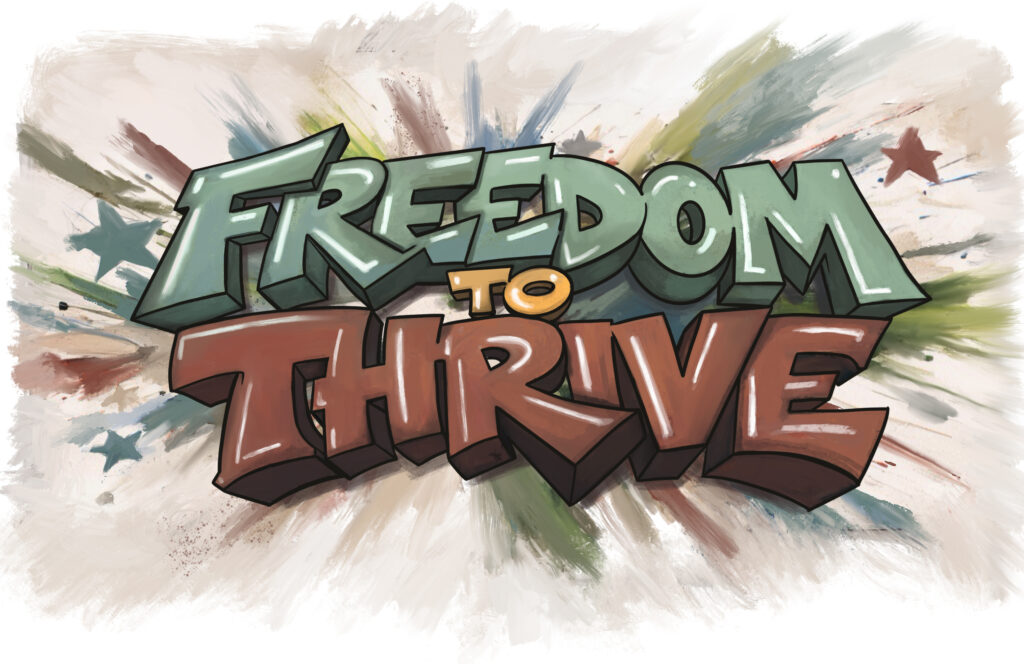
The freedom to thrive has never been granted. It has always been built — against dispossession, against redlining, against displacement, against the deliberate erasure of who was here and what they grew. That is what this exhibit is about.
Leah Penniman, co-founder of Soul Fire Farm in upstate New York, names what separation from the land costs. In her interview “To Free Ourselves We Must Feed Ourselves,” she documents USDA discrimination so systematic it drove Black farm ownership from fourteen percent of all American farms in 1910 to barely one percent today — sixteen million acres of land lost, and a conservative estimate of $326 billion in generational wealth that was never built, never passed down, never arrived. She writes with a faith that believes against all evidence: that our grandmothers braided seeds into their hair before the ships of the Middle Passage, carrying into the hold a belief in a future rooted in soil. Farming, for Black, Indigenous, and Chicano communities, is not a return to trauma. It is a refusal to let trauma be the end of the story.
Southside Colorado Springs knows what that separation costs. It lives in the health disparities, in the closed grocery stores, in the high percentage of renters with nowhere to go as upscale development moves closer. Hillside is currently identified as one of the five Colorado Springs neighborhoods most at risk of displacement. The history of who has been kept from land and food here is not history. It is the present.
This work does not belong to any one person or organization. It belongs to a community that keeps deciding — generation after generation — to tend what has been neglected, to plant where others said nothing could grow.
Rev. Dr. Promise Y. Lee — founding pastor of Relevant Word Christian Cultural Center, founder of the Hillside Neighborhood Association in 1987, the organizer whose work made the Hillside Community Center possible — comes from a long line of farmers and husbandmen and is a small-scale rancher himself. E.D. Rucker, that Community Center’s first director, also has a small homestead in the Arkansas River Valley in Penrose. The published agricultural histories of Fremont County catalog the orchard families, the cattle operations, the Italian immigrants who planted grapes. They are largely silent about Black growers in that same landscape. Two Black men, both ranchers, both architects of a community institution in the middle of a “food desert”: that juxtaposition is not ironic. It is the story. Kenny Callum — a subsequent director of the Community Center, Coach McKiernan’s first basketball captain in 1973, and the coach who gave Lawrence Walker of the W6 Foundation his first opportunity working with youth — understood the same distance between accesses to thrive and opportunities, and spent his life building the community that bridges it. June Waller has tended that same ground for six decades — rebuilding the city’s Housing Authority in the 1970s from within, planting senior and youth programs that still bear fruit, a champion for voting rights and fighting for the Leon Young Pavilion, named for the city’s first and only Black mayor. She still serves on the Hillside Advisory Team’s board today. A neighborhood’s harvest is never measured in one season.
That bridge has many builders — and they are not waiting for permission to break ground. Monycka Snowbird — Ojibwe farmer, urban homesteader in K-Land and the woman who changed city law — walked into the Colorado Springs City Council with a goat named Penelope and walked out having rewritten what food sovereignty is allowed to look like inside city limits. Her “No Goats No Glory” campaign did not just win a vote. It changed what this city permits its residents to grow. Courtney and Nicole Mallery of Freedom Acres Ranch, who purchased a thousand-acre Black-owned operation at the edge of El Paso County, have held their land against racial harassment and organized intimidation, refusing to let the forces that stripped Black farmers of sixteen million acres add one more acre to that count. Patricia Cameron founded Blackpackers and then hiked the entire 486-mile Colorado Trail solo in 2020 — the only Black person she saw on the trail the whole way — and used that momentum to further build an organization that ensures that will not always be true. Access to this land, even for recreation, is a move toward believing you belong on it. DeAndre and Jennifer Smith of OneBody Entertainment built the Southern Colorado Juneteenth Festival from nothing into one of the largest Juneteenth celebrations in Colorado — thirty thousand people have gathered at America the Beautiful Park, fed and celebrated and seen. That is more than a festival. That is a harvest. Joyce Salazar, Executive Director of RISE Southeast, has spent decades organizing residents from within — pushing the Southeast Strong Plan forward, fighting to keep community centers open, making plain that southeast Colorado Springs is not a problem to be managed but a community that has always known how to tend itself. Juaquin Mobley, publisher of the Pikes Peak Bulletin, is turning the newspaper into a tool for community ownership, because narrative is also land, and who controls the story controls what gets built. Ashley Cornelius, the first Black Poet Laureate of the Pikes Peak Region, tends language the way a farmer tends soil — because culture is the ground generational wealth grows in, before a single dollar changes hands.
Food to Power exists because that bridge has to be built, again and again, in every generation. The Hillside Hub farm produced close to seven thousand pounds of vegetables last year. Our composting operation has to date kept close to 2 million pounds of food scraps out of the landfill, regenerating them into soil-feeding compost. We deliver meals every Friday to thirty-four homebound residents, and we serve more than 44,000 food insecure households across Southeast Colorado Springs and El Paso County. These numbers are the measure of a community that decided to feed itself — to do, in this generation, what the families of The Dry did in theirs, what the betabeleros did in theirs, what the Ute did in theirs: tend the relationship between people and land with everything they had.
This exhibit is also an act of tending. The oral histories, the community curators, the stories placed inside these walls — all of it is cultivation. To name who is here. To refuse erasure. To put the record in a room where people can stand in front of it and see themselves, or see what has been hiding in plain sight. That is what foodways do. They carry what must not be lost from one generation to the next.
The land shaped the food. The food shaped the people. The Ute harvested bark from ponderosa pines with the knowledge of a thousand years. Nuevomexicano families brought water through the desert and bent their backs over sugar beet fields that fed a state that would not remember their names. The Black women of The Dry made unworkable land yield. Fannie Mae Duncan fed her community while the city worked to make her invisible. John Stokes Holley wrote them all down. Promise Lee preaches, organizes, ranches, and trains dogs now. E.D. Rucker tends his homestead in Penrose now, the Community Center behind them but not forgotten. Food to Power plants seeds in the middle of a food desert. This exhibit is part of that chain — an act of foodway preservation as much as historical documentation. These people were here. This knowledge is real. This land remembers, even when we have been taught to forget.
Consider again the bowl — seeds now fully grown into food. The hands that grew it. The hands that shared it. The seeds carried across oceans in braided hair, planted in ground that most people said would never produce, tended by people whose official histories chose not to see or document them. The bowl has not changed. But the ones who shaped it are more visible now, and so is the length of time this land has been loved. Plant the seeds anyway. They will grow.