1980 - 1989 Archives - CSPM

Lorem ipsum dolor sit amet, consectetur adipiscing elit. Ut elit tellus, luctus nec ullamcorper mattis, pulvinar dapibus leo.

EPA Lawsuits

Decades of water diversions bring water to Colorado Springs from other watersheds, so that rates of over four times the historical average now run downstream in Fountain Creek. Added to this are the vast areas of impervious surface built as the city developed in a classical pattern of urban sprawl that speed runoff and result in degraded water quality and stronger erosion downstream. The EPA sued Colorado Springs in 1978 and 1989 for water quality violations. By 1997, federal mandates required the EPA to regulate stormwater runoff. Colorado Springs created a Stormwater Enterprise in 2005 with a fee on landowners based on the percentage of property covered with impervious surface. Activists challenged this fee as a new “Rain Tax” not approved by local taxpayers and therefore unconstitutional according to the Taxpayer’s Bill of Rights. The courts agreed. The city then put to the voters a proposal to fund the Stormwater Enterprise, but this proposal was rejected in 2009 and the fee was eliminated. After audits in 2013 and 2015 of the city’s stormwater system, the EPA found that Fountain Creek and its tributaries were eroded, widened, and their waters combined with surface runoff to create excessive sedimentation and substandard water quality. The city again put a vote to the public in 2014 to fund stormwater infrastructure and again it was rejected. Pueblo was long concerned about increased runoff in Fountain Creek and demanded stormwater projects to control flooding. Pueblo threatened to suspend the permit for the new Southern Delivery System (SDS) pipeline from Pueblo Reservoir in April, 2016, unless Colorado Springs made a real commitment to stormwater management. Colorado Springs leaders promised the infrastructure projects, but voters repeatedly denied funding. The EPA and the Colorado Department of Public Health and Environment filed a lawsuit in November, 2016, accusing the city of violating its federal stormwater permit. Pueblo County and the Lower Arkansas Valley Water Conservancy District joined in the lawsuit as plaintiffs. In 2016, the two cities announced a 20-year, $460 million deal to correct Colorado Springs’ neglected flood control infrastructure. Then, on the third try, voters approved a stormwater fee in 2017 that will add to the pot. However, the lawsuit continued and the courts ruled against Colorado Springs in November, 2018, finding it guilty of violating its stormwater permit. Work continues to try to address the violations.

Generously Submitted by Dr. John Harner, Professor of Geography & Environmental Studies, University of Colorado, Colorado Springs

Imagination Celebration

For 35 years, Imagination Celebration (IC) has been instigating and shining a light on these very real experiences, throughout the Pikes Peak region and southern Colorado. The Kennedy Center for the Performing Arts in Washington D.C., founded the Imagination Celebration (IC) as a series of community-wide arts festivals throughout the U.S. In 1986, Colorado Springs became one of these national sites under the sponsorship of Joyce Robinson and the Colorado Springs Fine Arts Center. In 1989, Founding Director Mary Mashburn and the Pikes Peak Library District quickly developed it from a short-term festival to a robust medley of award-winning programs in the performing and visual arts. By January 2000, IC became an independent year-round nonprofit arts organization dedicated to connecting people to the brain-stimulating, community-building, life-enhancing power of creativity.

“Sprinkle, sprinkle” is the charming refrain frequently uttered by Mary Mashburn, the beloved Fairy Godmother of the Arts, while flourishing a wand and metaphorically sprinkling everyone with joy and possibilities. Mashburn and current director, Deborah Thornton (the Curious Choreographer of Creativity), have whimsical titles but underscore the seriousness of Imagination Celebration’s mission, sharing their concern: “There is a creativity crisis in America perpetuated by a focus on standardized testing and ‘right’ answers. Without creativity, we can’t find solutions to problems or develop new models of thinking. Brain research indicates we must be engaging children in music, movement and visual literacy to provide the advantages of a fully-developed brain capable of higher order thinking skills. A creative mindset is essential to a healthy, vibrant community!”

Over the years, a Steering Committee – Leadership Committee of over 75 organizations has addressed this challenge by collaborating with parents and teachers from 19 school districts, and thousands of volunteers to serve schools, community centers, family shelters, libraries, and nonprofit organizations, as well as towns that don’t have the resources of Colorado Springs.

75% of Imagination Celebration programs have focused on celebrating diverse cultures. Thousands of children and adults have enjoyed their first live performance through over 100 productions at the Pikes Peak Center ranging from West African dancers to Blues and Jazz musicians, African American history, Chinese Acrobats, Native American storytellers, an all-female Mariachi Reyna, and many, many treasured children’s books brought to life through the magic of theatre. Current programs at The Citadel mall focus on underserved families, active military and people with physical or developmental challenges.

What began as a festival, turned into a festival! On September 11, 2010, Imagination Celebration reclaimed a day known for destruction and launched an annual mid-September cross-pollinating celebration of creativity – the “What IF…Festival of Innovation and Imagination.” Over 50,000 people of all ages from every zip code in the region stroll among 6 city blocks to stretch their creative muscles with 100 hands-on activities from regional schools, businesses, and nonprofits, while experiencing the joy of live performance in poetry, music, dance and theatre. “What IF…” is the question that is posed before most creative endeavors.

What are your “what if’s” ?

Generously Submitted by Deborah Thornton, Imagination Celebration’s Curious Choreographer of Creativity

Bob Telmosse Christmas Giveaway

The Bob Telmosse’ Christmas Giveaway may have started as a practical joke but is has transformed into an annual act of community charity that has endured for more than three decades. The most unique feature of the Giveaway is its’ dedication to truly unconditional charity. Every year local community members donate toys and food to those in need during the holidays. The single-day event draws crowds of thousands and there are no stipulations about who can receive donations. Bob had a staunch “no questions asked” policy that continues to be the core tenant of the Giveaway.

The event started in 1983, when a crowd of people showed up to Bob’s business. Unbeknownst to him an anonymous prankster had published an ad for a charitable giveaway at his store. Bob asked the crowd to return later and promised he would have food to give away. Bob decided to create an annual event and moved the giveaway to coincide with Christmas to help those in need during the holidays. The event relies on community involvement and every year the community has donated food, toys, space, and time. The most popular item among kids are bicycles. For over a decade local business Ted’s Bicycles has helped repair and tune-up donated bicycles, all free-of-charge.

The Christmas Giveaway has become an essential holiday fixture in Colorado Springs. Since Bob’s death in 2006 the people of Colorado Springs and the organizers of the event have continued the Giveaway every year, even during uncertain times. In 2007 the event was cancelled because a venue could not be secured. A local business owner stepped in to host the event. Although there was less than a month to prepare and secure donations the Giveaway went off without a hitch. In 2020 the COVID-19 pandemic prevented the event from being held in its’ traditional format. The organizers adapted to a drive-through format and requested gift card donations in lieu of toys.

Bob Telmosse’ took a prank and created an event that inspired members of a community to unconditionally support one another, year after year. Bob wanted to help anyone who needed it and never wanted anyone to feel shame for being in a tough position. As Bob said, “Every person’s dignity is respected. It’s just people from all walks of life, helping other less fortunate people also from all walks of life.”

Generously Submitted by Patrick Lee, CSPM Museum Technician

KRCC

The story of KRCC began in earnest with a war surplus FM transmitter in 1951. In the mid-1940s Colorado College Professor Woodson “Chief” Tyree set up a broadcast studio at the college. Professor Tyree, along with his students, would transmit through local stations KVOR and KRDO. In 1951 Margaret Merle-Smith suggested that they should start their own radio station. Merle-Smith found and purchased an old military transmitter. Fellow student Charles “Bud” Edmonds got the transmitter set up and broadcasting. The station originally transmitted on 91.3 but when Harry Hoth, then owner of KRDO, requested the frequency for his own use KRCC moved to 91.5, the frequency it still broadcasts on to this day.

By the mid-1970’s KRCC had grown to have a staff of 35, mostly student volunteer, employees. The broadcasts mainly focused on material other local radio stations weren’t broadcasting. The radio station would broadcast six hours of classical music a week as well as a performance by the New York Philharmonic every Tuesday night. They also had Colorado College specific material, such as breakfast reports. The morning DJ would run the show until they had to dash off to class, and during the traffic report a student would imitate the sound of a helicopter to create a recognizable radio atmosphere.

The station took its next big step in 1984. Under direction of station Director Mario Valdes, who had started at the station in 1979 and became its first paid employee in 1980, KRCC greatly expanded. In 1983 KRCC received a grant of $60,000 from the United States Department of Commerce to assist in erecting a transmitter on Cheyenne Mountain. The next year KRCC began operating the new transmitter which allowed them to expand to listeners in Fountain, Monument, Palmer Lake, Black Forest, and Falcon. That same year KRCC became a National Public Radio (NPR) affiliate.

KRCC’s expansion has been slow but continual. In 1992 the station moved to its current home at 912 North Weber Street. In 2005 the station began broadcasting its’ local news show Western Skies, which now has daily segments during NPR’s Morning Edition and in 2008 KRCC finished installation of an HD broadcasting system. In February of 2020 Colorado College turned over the operations of KRCC to Colorado Public Radio. Although no longer affiliated with Colorado College KRCC still retains its local focus and continues to operate in Colorado Springs.

Generously Submitted by Patrick Lee, CSPM Museum Technician

Space Foundation

Every American flag has a story and this one is no different. In fact, this American flag was flown to space onboard “Exploration Test Flight 1,” on December 5, 2014 as part of the first test flight of the Orion multi-purpose crew vehicle. Built by Lockheed Martin, the Orion capsule is part of NASA’s plan to put humans back on the Moon and eventually send them to Mars. This flag was part of Orion’s payload. The flight’s success was owed in part to Colorado companies, such as Denver based, United Launch Alliance (ULA) which provided the Delta IV Heavy rockets used in the launch.

By itself, the orbital journey of this flag is quite remarkable, but at the Space Foundation and Space Foundation Discovery Center, both located in Colorado Springs, sharing the remarkable is part of our everyday mission. As the country’s premier organization that inspires, educates, connects, and advocates for the global space community, we are proud to carry on Colorado Springs’ long history of involvement of pioneering and space exploration.

From the establishment of NORAD in 1958, to the establishment of Space Command and Space Force, Colorado Springs has always been a home to the space community. Established in 1983, Space Foundation has worked to connect the diverse sections of the space community – industry, government, military, education, international – and bring them together to share interests and work towards common goals. The culmination of these efforts is the annual Space Symposium, which brings over 15,000 attendees from around the world to Colorado Springs – making it not just the largest gathering of its type for the Pikes Peak region, but the most renowned assembly in the global space community.

But bringing the space community is just one part of Space Foundation’s mission – preparing for the future is the other. Working with teachers, students and parents around the world, Space Foundation offers in-person and online, digital programming, content and curricula to ready students of all ages to be future space explorers, innovators and entrepreneurs. All of these efforts are headquartered at Space Foundation Discovery Center (SFDC), the region’s only interactive museum and science center dedicated solely to space exploration. Located close to Garden of the Gods, SFDC connects space to our everyday lives and inspires the next generation of space explorers through its exhibits, immersive lab experiences, and educational programming.

Generously Submitted by Rachel English, Space Foundation Discovery Center Curator & Registrar

Trails and Open Space Coalition

How do you summarize 33 years in 400 words?! The Pikes Peak Area Trails Coalition was born when a group of community leaders including John Maynard, John Covert and Brian Gravestock, decided the region needed committed trail champions to advocate for the new city trails master plan. As there was limited funding to build new trails, there was a real danger the plan would never be realized. An energetic board member – Skye Ridley – took on the challenge, became the first executive director and began working to complete the Pikes Peak Greenway. When she left the organization a retired full colonel took over. Under Dan Cleveland’s leadership PPATC became the Trails and Open Space Coalition adding open space advocacy to its mission.

The passage of the TOPS Tax was one of Dan’s early priorities. During his tenure, TOSC advocated for the first PPRTA to include a small percentage for trail construction. And once TOPS passed, Dan attended TOPS and Parks Advisory Board meetings, advocating for open space purchases and trail connectivity. Red Rock Canyon, Stratton, Cheyenne Mountain State Park, Blue Stem Prairie, Blodgett Peak open spaces – thousands of acres were preserved thanks to TOPS with help from TOSC.

TOSC led the charge to save Corral Bluffs from becoming a motorcycle park. TOSC fought efforts to turn Bear Creek Regional Park into a golf course. When El Paso County no longer wanted Section 16, (along Gold Camp Road) TOSC convinced city parks staff to purchase it and make it part of Red Rock Canyon Open Space. One of TOSC’s biggest trail successes was the connection of the New Santa Fe Regional Trail to the Pikes Peak Greenway.

Over those years, battles were lost. TOSC supported passionate Teller County residents to get a parks tax passed – but it failed. An effort to turn Ben Lomand in Palmer Lake into a county open space was unsuccessful. When the recession hit and parks budgets were gutted, TOSC launched a campaign to create a Parks District to provide adequate funding for parks in our region. EPC Commissioners refused to place it on the ballot.

Nevertheless, we’d like to think General William Palmer would be pleased with the number of acres of open space and miles of trails we now have in our community. It certainly reflects his vision. As for today’s Trails and Open Space Coalition and the TOPS program – we’re only getting started!

Generously Submitted by Susan Davies, Executive Director, Trails and Open Space Coalition

The Archuleta Family

The Archuleta family are descendants of the Hispano families who journeyed to the Spanish northern frontier in Colorado’s San Luis Valley in the seventeenth century. The adobe brick and six armed cross pictured are representative of not just this long family history in the state, but also the greater history of the Hispano people in Colorado. These artifact/s are on loan from the San Juan Bautista Spiritual Center in La Garita Colorado courtesy of the Archuleta family foundation.

The Hispano people are unique to the American southwest descending from Spanish settlers and Indian natives and they have left a unique cultural imprint on the state of Colorado. The Archuleta family, led by patriarch and matriarch Celestino and Marcella, has remained in southern Colorado for seven generations contributing to local history, business and the arts, particularly in the San Luis Valley and in Colorado Springs.

History of the San Luis Valley
Colorado’s San Luis Valley is among the first explored and earliest settled regions by Spanish Europeans in the sixteenth century and encompassed the northernmost frontier of Spanish New Mexico. Centuries before these Spanish Europeans explored the high mountain valley of San Luis, it was home to the Ute, Apache, and Navajo Indians who traveled and hunted buffalo herds on the land.

Due to a long history of cultural isolation, the region of northern New Mexico and Southern Colorado developed a unique Hispano Culture that influenced all aspects of life including dialect, cuisine and faith in the area to this day.

Emboldened by Conejos land grant that was established to encourage settlement in the region Hispanos left their homes in Santa Fe and Taos to settle in the San Luis Valley. La Garita soon became the chosen site to build a much-needed parish church and cemetery to serve the newly established community. Built on land donated by Captain Julian Espinosa and his wife, Rufina Montoya. Capillia de San Juan Bautista was completed in 1879, dedicated to Saint Bautista on his catholic feast day of June 24.

Also in 1879, an adobe dwelling was built east of the San Juan Bautista church as a casa de cura (rectory) for Jesuit Priests serving the community. Later, the dwelling would serve as a convent (convento) for the Sisters of Loretto at the Foot of the Cross. The last remaining wall of this dwelling has been preserved as a monument with frescos created by Anthony Archuleta that are dedicated to the courageous Hispano people who first settled in La Garita. The adobe brick artifact (pictured) comes from this wall which is among the oldest still-standing structures in the San Luis Valley.

In 2012, artist Anthony Archuleta completed work on the largest outdoor buon fresco rosary walk in the world. The rosary walk, erected in front of the Capillia de San Juan Bautista contains twenty-six original frescos depicting the Mysteries of the Rosary. Located at the gateway to Penitente canyon between the majestic San Juan and the Sangre de Cristo mountain ranges the largest of the frescos is over fourteen feet tall.

Relocating to Colorado Springs
It was Celestino and Marcella Archuleta who were the first in the family to leave the San Luis Valley and settle in Colorado Springs. In the early 1960’s, Celestino and Marcella would leave the valley seeking more opportunity and better education for their children. However, they brought with them to Colorado Springs the values of faith and family established through an intricate and unique history of Hispano people in the San Luis Valley.

The Archuleta’s initially lived near the Conejos neighborhood located near downtown Colorado Springs but soon moved to the newly established neighborhood of Pleasant Valley where they were the first and only Hispano family in the community for many years (photo). Celestino and Marcella would go on to start a very successful business in Colorado Springs that employed over 400 individuals and they are blessed with 5 children, 7 grandchildren and 3 great-grandchildren who are active in the community as educators, activists, artists, and business leaders alike.

Generously Submitted by Alex Archuleta, Historian

NHACS / AAHGSCS

In 1981, NHACS was founded with the mission to preserve and spread awareness of Black history in the Pikes Peak Region. Its goals were to instill a sense of pride in young people in the Black community and to share and celebrate the culture and contributions of Black people throughout the region.

Lulu Pollard was at the center of the founding of this important Society, the nurturing of its community and mission, and the building of a collection— of stories, documents, objects, photographs and oral histories—that now serves as the foundation of growing Black history collections in the Pikes Peak Region. This includes collections at the Pikes Peak Library District, the Colorado Springs Fine Arts Center, the Colorado Springs Pioneers Museum and AAHGS’s African American Museum at the Westside Community Center.

Born in 1917, Pollard was part of the large and respected Stroud Family of Colorado Springs. She broke barriers throughout her education and career. In 1951, Pollard became the first Black person employed by Fort Carson’s Civilian Personnel Office. At the end of her career, she became the first full-time Equal Opportunity Officer for the Military Traffic Command in Washington, D.C.. Upon returning to Colorado Springs after retirement in 1979, Lulu and her husband, Leonard Pollard, noticed a void of recorded local Black history. She was poised to lead the movement to change that.

Preservation, education, exhibit, and outreach initiatives included multiple publications that recorded and shared significant—and widely unknown— Black history of the region. The publications also shared current events and accomplishments of the Black community. To further share these stories, NHACS members spoke in local schools and created, or sponsored, exhibits at Penrose Library and the Colorado Springs Pioneers Museum. They established the Shivers African American Cultural Collection at the Penrose Library and advocated for the sculpture of William Seymour in Alamo Square. In 1985, under the direction of NHACS, Payne Chapel AME Church was designated a state historical site.

In June 2004, following Pollard’s retirement, Candice McKnight became president of the NHACS board of directors. In 2005, NHACS merged with the African American Genealogical Society of Colorado Springs (AAGSCS). In the spirit of Pollard and the founders of NHACS, McKnight has said “We have to keep this alive. If we don’t who will? It’s a lot of work, but if you love it, it’s not hard.” Indeed, the spirit and visionary work of NHACS has had a resounding effect in the preservation, appreciation and interpretation of local Black history throughout the Pikes Peak Region.

Generously Submitted by Hillary Mannion, CSPM Archivist

Marshall Sprague

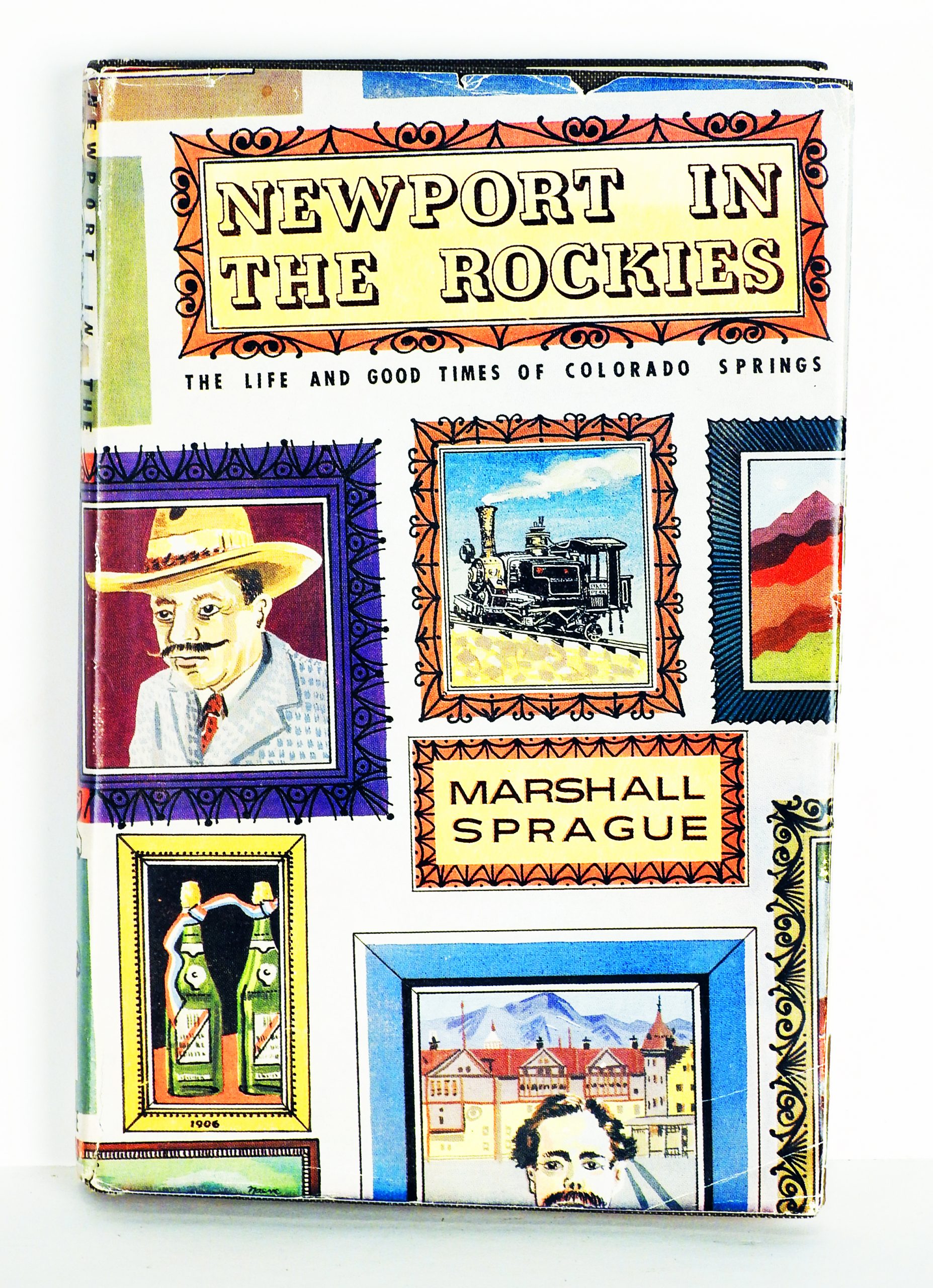
Marshall Sprague (1909-1994) was the journalist and popular historical author whose book—Newport in the Rockies: The Life and Good Times of Colorado Springs (1961)—became known as the history of Colorado Springs. Witty and gossipy, the book took on a life of its own as the reference offered newcomers. Long-time Chinook Bookstore owner Dick Noyes said it was his perpetual bestseller, calling Sprague the town’s “Historian Laureate.”

Sprague became a local character himself. He arrived, like so many, with tuberculosis, seeking the famous local specialist Dr. Gerald Webb. Sprague’s first book was the story of his recovery: The Business of Getting Well (1943). During prescribed rest, he also read history books that inspired him to write them. Sprague made a place for himself in Colorado Springs that would last 50 years.
Sprague developed local-regional history books that no one had written. He wrote about the Cripple Creek Gold Rush, the Meeker Massacre, “dudes,” who went to the Wild West, the Rocky Mountain passes, the Louisiana Purchase, and the Colorado volume of a U. S. bicentennial series of every state’s history. He “never claimed to be a historian,” he said; “I am a feature writer and proud of it.”

Sprague and his wife Edna Jane (“Ejay”) were active in politics and the arts. She performed in the Civic Players and he played piano for a jazz band, the Gut Bucket Seven. In 1958, they joined Colorado Springs’ progressive leaders in an anti-nuclear campaign. In 1969, they defended Colorado College for hosting an anti-violence symposium. Ejay served on the city’s park board, ran for council advocating open space, and was Vice President of the Board of Trustees for the Fine Arts Center. She became the first woman to serve on the planning commission, where she advocated preservation over urban renewal.

Sprague set out (at publisher’s urging) to make Newport a “gay book,” basing it on “widely-circulated” stories that “the Springs heard.” By writing these, he sacrificed Queen Palmer, bride of town founder William Jackson Palmer. Some townspeople resented her for apparently not appreciating her husband or his town enough to stay indefinitely. Newer local historians apply scholarly standards of research and accuracy to local history. They struggle with Sprague’s Newport still being the history of Colorado Springs. Nevertheless, it has that colorful life of its own and Sprague never did claim to be a historian.

Generously Submitted by Katherine Scott Sturdevant, Professor of History, Pikes Peak Community College

Pikes Peak Center

The Pikes Peak Center for the Performing Arts, located at 190 South Cascade Avenue, was built in 1982 as part of the downtown Colorado Springs economic revitalization program. The goal of its establishment was to provide El Paso County with a regional cultural center for performances and educational programs. However, during the construction phase it had reached international acclaim for its progressive and advanced acoustic technological design.

Every detail of the building is designed to deliver a near perfect acoustic experience for audiences. A sound booth is located in the middle of the main level of continental seating so that a sound technician can hear exactly what the audience hears and adjust acoustic levels accordingly. The water pipes are suspended on springs to eliminate vibrations, the walls are coated with epoxy to create a smoother surface for the sound waves to reverberate off, and the basement is constructed on separate support pillars from the rest of the building so no vibration is transmitted from other areas of the building.

The seating for the auditorium is separated into four sections: the orchestra, loge, mezzanine, and balcony totaling 2,000 seats. The auditorium is designed with an oblong shape surrounded by 15 acoustic towers. The PCC was also one of the first in the Rocky Mountain region to use a computerized lighting system where lighting cues could be saved onto a floppy disk. The computer would run all the light cues without the need for lighting technicians to worry about missing cues or using the wrong effect. But if a performer made a mistake such as missing a line, the technician could pause the computer and re-time the rest of the cues.

Since its grand opening on October 21, 1982, artists and critics have praised the center for its design as well as its numerous programs and shows. The building symbolized the desire of the Colorado Springs community to support the arts on a new level. For the first time excited local residents could see Broadway shows without having to travel to Denver. The annual performance of The Nutcracker by the Colorado Springs Philharmonic has become a holiday tradition for thousands of residents. The center is also the home of the Colorado Springs Symphony.
The opening and continued success of the center is attributed to the passion and determination of Bee Vradenburg. As the general manager of the Colorado Springs Symphony for 37 years, she lead the push for the center’s construction, had wizard-like abilities to find funding for the building and numerous programs, and is considered “a legend in the orchestra world” for her ability to grow the Colorado Springs Symphony from a fledgling operation into an 82 member organization that receive national attention. Vradenburg is known for creating the strong connection between the Colorado Springs community and the symphony. In her own words the construction of the PCC was “the highlight of what I have done and has brought me the greatest joy.”

Generously Submitted by Heather Poll, M.A.