1900 – 1909 Archives - CSPM

Lorem ipsum dolor sit amet, consectetur adipiscing elit. Ut elit tellus, luctus nec ullamcorper mattis, pulvinar dapibus leo.

Midland Band

1894: The Midland Band is formed.

The Midland Band achieved national recognition and delighted regional residents across three decades.

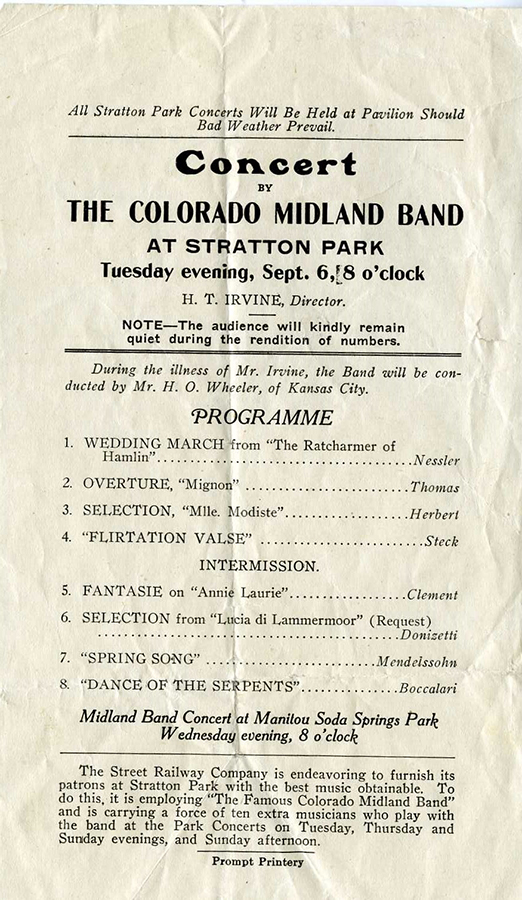
Howard Greenough of Colorado City began thinking about a band for Colorado City residents as early as 1889. Comprised of twelve musicians–mostly Midland Railroad workers–the Colorado Midland Band made its first public appearance on June 12, 1894.  The band quickly gained popularity and won first place in a competition between 22 bands at Denver’s Festival of Mountains and Plains in 1896.  By 1898 it had 35 accomplished musicians, performing classical music as well as popular tunes and marches.  Wearing Ute Indian costumes as their signature style, all musicians had to sign a pledge to avoid drinking alcohol.  Known for the exceptionally high character of its concerts, the band moved from Colorado City to Colorado Springs in 1900 seeking to become the leading band west of Chicago.  The Gazette called it one of the best bands in the country. Thousands came to Stratton Park (at the end of the streetcar line in Cheyenne Canyon) four times per week. The band would often play in one city park in the morning and another in the evening.  Winfield Scott Stratton donated $1,000 in 1900 for new uniforms and a bandstand was built in Monument Valley Park for them to play.  At one point the band had as many as 50 pieces and played throughout the state and at other national venues. They achieved a fame enjoyed by few other bands in the country.  Claiming that no tourist season would be complete without their concerts, the Gazette—the bastion of private enterprise and limited governance–called for municipal ownership to ensure the band’s solvency and reduce the need for constant fundraising.  By 1918 the band was a city-owned entity with 24 musicians: 11 brass instruments, 11 woodwinds, and 2 drums.  By the mid-1920s the band languished and ceased playing but nonetheless made a lasting impression on the region and the state during their heyday.

Maude McFerran Price

Maude McFerran was born in Gallatin, Missouri on February 8, 1864. She came to Colorado Springs in 1873 when the town was only two years old, and lived here 68 years. Maude McFerran Price passed away on March 3, 1941.

She married William W. Price on January 26, 1893 and became one of the leading forces in the grown and intellectual development of the burgeoning town. Maude attended Colorado College, receiving honors in music. In 1907, she wrote the words and music of the song Colorado which became the official song of the Daughters of the American Revolution and the Colorado Federation of Women’s clubs. She was actively involved with the Half Century Club, whose members had to have lived in Colorado for 25 years or more.

In the 1890s, Maude became highly involved with the El Paso County Pioneers Association (EPCPA). She was elected president for 10 years and then was named honorary president for life. When the EPCPA undertook the collection of relics for a museum, Mrs. Price was named to take charge. Many of the citizens who were the first settlers to arrive in the region turned over to her articles of priceless historical value. She lobbied the city for decades until they purchased a building to house the museum collection.

The Anne Gates colonial collection was given with the provision that they should not be displayed until a suitable fireproof museum building could be obtained. Price took in donations and filled her home with them until the building at 25 West Kiowa Street was purchased and the collection housed there. The City created the office of assistant curator, and a museum commission also was formed to assist. Mrs. Price gave many of her own things to the museum and established an exhibit of glassware, which she installed in memory of her parents. Before the permanent museum, Price and the EPCPA displayed their many donations in the El Paso County Courthouse, the permanent home of the Colorado Springs Pioneers Museum.

Mrs. Price was president of the Rocky Mountain district of the National Federation of Music Clubs of America. She was regent of the National Society of Colonial Dames, active in D.A.R., and belonged to the Drama League. Maude McFerran Price was tireless in working for the betterment of her city and deserves our thanks.

Generously Submitted by John Orsborn, CSPM Volunteer Educator

Pythian Sisters

This robe is one example of nine in the museum’s collection worn by Pythian Sisters of Colorado Hermione Temple 1. Each is a different color depending on the position. During the decades following the Civil War, fraternal orders and secret societies held significance at the local, state, and national level. Membership grew in existing groups and new organizations. This “Golden Age of Fraternalism” corresponded with the founding and growth of Colorado Springs.

Fraternal organizations provided members entertainment, companionship, identity, and for some, mutual aid, such as insurance. Colorado Springs supported a large number of fraternal orders with the 1900 directory listing among others: the Ancient Order of the Pyramids, Benevolent and Protective Order of Elks, the Independent Order of Odd Fellows, and of course, the Freemasons. In 1910, the city directory listed over 29 different “secret organizations,” many with multiple lodges or chapters.

Justus Rathbone founded the national Knights of Pythias in 1864. He drew inspiration to create the order’s rituals from the friendship of Pythias and Damon. The first local Knights of Pythias Lodge, Myrtle Lodge No. 34 formed in 1888. The women’s auxiliary, the Pythian Sisters of Colorado Hermione Temple No. 1, soon followed in 1891. Other Pythian groups emerged, including Syracuse Lodge No. 111 and Sublime Temple No. 34, but they merged with the larger Colorado Springs organizations. Old Colorado City and Manitou Springs had their own Knights of Pythias and Pythian Sister lodges.

Black men joined Damon Lodge No. 2 that operated during the 1890s or beginning around 1904, the Pleasant Home Lodge No. 6 at 124 East Huerfano. While black Knights of Pythias had the same name, both nationally and locally they were considered to be separate organizations. A majority of the other lodges held their meetings at the Knights of Pythias Hall in the McIntyre Building at 107-109 N. Tejon Street.

In 1913 the local Knights of Pythias purchased the Majestic Block on East Bijou for $45,000. They renovated the second floor into a temple, lodge rooms, clubrooms, a banquet hall, library, and reception room. At the time, the Knights of Pythias numbered over 400 members and the Pythian Sisters over 200. To celebrate the opening, the Knights and Sisters held a reception with musical programming.

Submitted by Caitlin Sharpe, CSPM Registrar

The City of Sunshine

Tuberculosis (TB) was a mysterious disease and the most common cause of death among those in their productive years in the late nineteenth century. Because there was no medicinal cure, the preferred treatment became a search for a healthy climate to help patients regain strength. The idea of a sanatorium, based on European health resorts and spas, grew to become the places to seek a cure. At sanatoriums, TB patients were encouraged to live outdoors, breathe fresh air, eat nourishing food, and transition from rest to an active exercise routine once health began to improve.

From its founding in 1871, Colorado Springs quickly gained a reputation as a restorative location, partly in response to national trends about the curative power of western air and nature, but also due to overt marketing by early city elites and physicians who themselves located here to recover from TB. General Palmer’s friend and business partner Dr. Edwin Solly promoted the region as a health resort, and he became a leader in promoting the climate cure.

Colorado Springs became known as a most desirable destination for chasing the TB cure and adopted the slogan “The City of Sunshine.” Many sanatoriums located in the region, including the Union Printers Home, Modern Woodmen, Beth-El Methodist, and others. Both Memorial and Penrose Hospitals began as TB sanatoriums.

The most exclusive sanatorium was the Cragmor Sanatorium at Austin Bluffs. Palmer donated 100 acres and a sum of money in 1902 to his friend Solly, who consciously patterned the complex after the most famous and well-established resort at Davos, Switzerland. Its later director, Dr. Alexius Forster, emphasized physical comfort, relief from stress, positive thoughts, and was deliberately unconcerned with rules. Cragmor grew and prospered, admitting wealthy, influential consumptives who were a gregarious lot, even publishing their own journal Ninety-Eight-Six in reference to the ideal body temperature to which they all strived. By 1924 the National Tuberculosis Association called it the most desirable sanatorium in the world.

In 1943 Dr. Selman Waksman found that the antibiotic streptomycin completely suppressed the activity of the tuberculosis bacillus. For nearly a century the sanatorium was the preferred treatment prescription, but after barely a decade they were gone, their services no longer needed. Cragmor continued with a federal grant to serve Navajo patients, but closed in 1962. The main building is today’s Main Hall at UCCS.

Generously Submitted by Dr. John Harner, Professor of Geography & Environmental Studies, University of Colorado, Colorado Springs

Colorado Springs Parks

City parks have always been integral to Colorado Springs. Central to General Palmer’s vision was the establishment of an interconnected park system. The Colorado Springs Company donated land for Acacia, Alamo, and Antlers Parks after the city’s founding, and Palmer donated thousands of additional acres for more parks such as North Cheyenne Canyon, Palmer Park, and what he saw as most important, Monument Valley Park.

In 1907 he created an independent Parks Commission to manage public parks, and by 1910 the City Council had created a Department of Forestry with a city forester. In 1909, Charles Perkins donated the Garden of the Gods to the city, adding to the reputation for magnificent parklands that the Gazette said were “famous the world over.”

The city outgrew the ability of a volunteer body to administer its parks, so on April 1, 1947, the Parks Commission charter was repealed and the city Department of Parks and Recreation was created. One of its first initiatives was to expand the land holdings around Prospect Lake and create Memorial Park in 1948.

The number of city parks grew greatly after the 1960s and the Parks Department emphasized recreational opportunities. Whereas the city had long relied on wealthy benefactors to donate land for parks, a 1973 ordinance required developers to set aside land for parks, ensuring that growth in parks would to some degree meet the growth in population. The first parks master plan for the city was produced in 1976.

In 1980 the state began using lottery funds to purchase parkland, and this was strengthened in 1992 with the creation of the Great Outdoors Colorado (GOCO) program and by local taxpayers approving the Trails and Open Space sales tax in 1997. Despite these funding sources, the Parks and Recreation Department has suffered reduced personnel and budget, especially after the economic crisis of 2008.

Today city parks increasingly rely on volunteers. Despite being underfunded, dedicated citizens have worked to ensure that the city’s parks, trails, and open spaces remain vital and serve the public good. The contemporary Department of Parks, Recreation, and Cultural Services administers over 9,000 acres of parkland and over 500 acres of trails, plus sports complexes and education centers, including the Colorado Springs Pioneers Museum.

As former Department Director Nancy Lewis stated in her book The Parks of Colorado Springs, parks remain integral to the community’s identity.

Generously Submitted by Dr. John Harner, Professor of Geography & Environmental Studies, University of Colorado, Colorado Springs

Van Briggle

Artist Artus Van Briggle (1869-1904) was one of countless tuberculars attracted to Colorado Springs because of its reputation as a health resort. When he arrived in the spring of 1899 at the age of 30, he had succeeded in recreating a matte glaze dating back to the Chinese Ming Dynasty, a technique he would perfect while residing in Colorado during the few remaining years of his life.

Originally from Ohio, where he apprenticed at the famous Rookwood Pottery, his employer recognized his talent and financed an overseas stay in Paris from 1893 until 1896 to further his studies. It was there that he met and became engaged to fellow American artist, Anne Gregory, but after their return to the United States, they lived in separate states until Anne followed him to Colorado in 1900, where they married two years later. In their home on North Nevada Avenue, they created beautiful pottery in the Art Nouveau style, which was hailed regionally and nationally, and which bore their trademark, two intertwined letters “A” within a square.

In 1903, all 24 submissions to the Paris Salon were accepted, a remarkable achievement in and by itself, but they also received 2 gold, 1 silver, and 12 bronze medals. Of 100 pieces sent to the St. Louis World’s Fair in 1904, 2 were crowned with gold, 1 with silver, and 2 with bronze. Alas, while the fair was underway, Artus succumbed to tuberculosis, and the Van Briggle exhibit in St. Louis was draped in black crepe. Subsequently, the El Paso County commissioners purchased what pieces of the collection had not been sold and donated them to the El Paso County Pioneers Association, precursor of the Colorado Springs Pioneers Museum. They were displayed in the halls of the 1903 El Paso County Courthouse, long before any inklings of its future as the home of our local history museum. They also formed the beginning of what has since grown into the largest collection of Van Briggle pottery in the country, numbering over 700 pieces. Following Artus’s death, Anne continued to operate the pottery, and in 1908, moved into its new artistic home at the north end of Monument Valley Park on land donated by city founder, General William Jackson Palmer. Anne sold the business in 1912, but Van Briggle-style pottery continued to be produced by a series of owners in a variety of locations until 2012.

Generously Submitted by Tanja Britton, CSPM Volunteer Educator

Winfield Scott Stratton

Nobody thought that gold would be discovered in 1890 some 20 miles from Colorado Springs. So when “Crazy Bob” Womack, a local cowboy, came to town from Cripple Creek in October, 1890 with gold-bearing ore, few gave him credence. Yet the boom was real, so that by 1908 at least 28 Colorado Springs residents had become millionaires due to Cripple Creek gold.

One of those who struck it rich was Winfield Scott Stratton, a local carpenter and part-time prospector. He was the first to strike big returns with his Independence mine, which he tried to sell in 1891 for $500, did sell for a $5,000 down payment in 1892, then reclaimed it in 1893 when the buyer was disillusioned. In July 1893, he hit a major vein and eventually sold the mine in 1899 for $11 million.

Stratton remained loyal to his blue collar roots, giving away most of his money, building the Colorado Springs trolley car network and investing $2 million to create top-class service, constructing the Mining Exchange Building, donating land for City Hall and the U.S. Post Office, and buying the El Paso County Courthouse so a new one could be built (today’s CSPM). Stratton also insisted on paying good wages and providing life insurance to his trolley line workers (the first corporation in Colorado to do so), financed a home-buying plan for his trolley workers and bought homes outright for other employees, and built the popular park at Cheyenne Canyon, at the end of his trolley line, for residents to enjoy weekend outings.

Stratton continued to live in his humble house on Weber Street, but became increasingly morose and removed from society. He bemoaned the constant pleas for charity from nearly everybody and scammers vying for his wealth. He turned hard to whiskey, eventually fell into a coma, and died at age 54. Upon his death in 1902, Stratton willed his wealth to create the Myron Stratton Home for the poor without means of support or unable to earn a livelihood. The Myron Stratton Home opened in 1913. From the time of Stratton’s death in 1902 to the mid-20th century, his estate operations produced gold worth over $10 million, all for the benefit of the residents at the Myron Stratton home. This one person, in the end an unhappy loner, left a deep and lasting impact on the landscape of Colorado Springs.

Generously Submitted by Dr. John Harner, Professor of Geography & Environmental Studies, University of Colorado, Colorado Springs

Thomas MacLaren

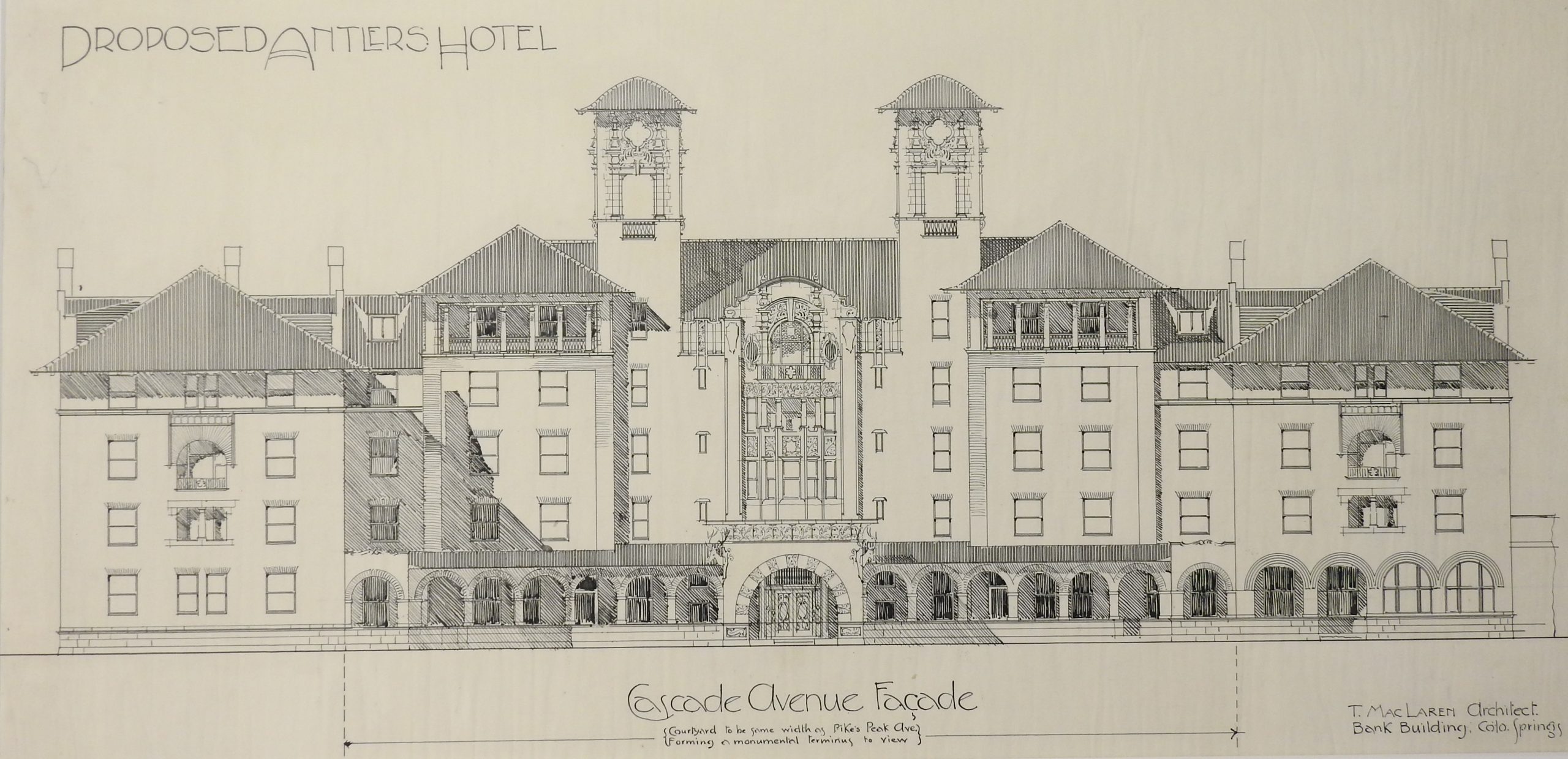
Thomas MacLaren’s design for the Colorado Springs residence of the Baldwin family, known as Claremont, was based on the Grand Trianon at Versailles, which MacLaren studied in person. Although it may be the design which he is most associated with, MacLaren was not particularly fond of the project, as it was simply a copy of another design. However, it remains one of the many works of Thomas MacLaren’s life that stand as an enduring link between Colorado Springs and Scotland, and the Scottish migrant community that settled in Colorado Springs.

Thomas MacLaren was born on February 19, 1863, he was raised on the family property in the Scottish Highlands. In 1880, still a teen, MacLaren followed his brother, James Majorbanks (also an architect), to London to begin his architectural training. From 1882 to 1891 MacLaren earned several prestigious professional awards and travelled extensively throughout Europe to study and sketch. In 1892 he was admitted to the exclusive Royal Institute of British Architects. Thomas MacLaren immigrated to the U.S. in 1893, settling in Colorado Springs for his health.

Upon his arrival in Colorado Springs, MacLaren found a place “being only 30 years a settled country” where “no native Coloradan” architectural tradition was to be found. This absence of a native architectural tradition allowed MacLaren to adapt and experiment with his designs, and to evolve and expand his thoughts on the built environment in a new land. The result was an eclectic mix of architectural styles fused to design buildings, churches, and homes in Colorado Springs that are as authentic and unique as any American city can boast.

A prolific designer, up to 80 of MacLaren’s designs still stand in Colorado – the majority in Colorado Springs. Of these, twelve are designated on the National Register of Historic Places and three are designated on the State Register of Historic Places.
In addition to his architectural work, MacLaren is also credited with numerous philanthropic achievements. Notably, leading the efforts of the Caledonian Society of Colorado Springs in raising funds for the construction of a residence to house injured Scottish veterans of WWI at Longniddry, Scotland. The “Colorado Springs Cottage,” in the first settlement of the Scottish Veterans Garden City Association, continues to house injured Scottish veterans to this day.

Thomas MacLaren died on December 4, 1928, from complications following surgery for stomach ulcers; he is buried in the Evergreen Cemetery in Colorado Springs.

Generously Submitted by Barry Binder, Historian

Carnegie Library

Built using matching funds provided by Andrew Carnegie, the architecture of the 1905 Carnegie Library represents a promise between the library and the citizens of Colorado Springs. The rich construction materials showed the public the stability of the new institution, known then as the Colorado Springs Public Library. Dedicated child-sized tables and chairs demonstrated the library was for all ages. The grand views from the reading room integrated the library into both the built and natural landscapes. From its earliest beginnings, the library was a community hub.

For over 50 years, the Colorado Springs Public Library and the West End Library (now the Old Colorado City Library) provided services to the city. In 1963, the Pikes Peak Library District was formed as a special district, incorporating existing libraries in outlying areas such as Palmer Lake and Ute Pass.

With additional patrons, the sixty-year-old Colorado Springs Public Library needed additional space. In 1966, the construction of Penrose Library expanded the library’s ability to meet increased community expectations. The expansion included an enlarged children’s section, cataloging and processing areas, and an auditorium. The original Colorado Springs Public Library was linked to the new Penrose Library.

As Colorado Springs rapidly grew east, a library was needed to serve that area. The first East Library was established near the intersection of Academy and Constitution in 1973. In 1987, the East Library and Information Center opened at its present location. The new library’s architecture took visual ques from the design of the historic 1905 Carnegie Library and included a silver finish to modernize its look. The library included a video center, a remote DMV office, and Maggie’s Place, the world’s first online catalog.

Responding to changing community needs, Pikes Peak Library District continues to adapt. Library 21c encourages patrons to examine their view of how a library serves its community with multiple makerspaces, public meeting rooms, a recording studio, and business incubator. Rapidly adapting to the 2020 Covid-19 Pandemic, library staff members reinvented service practices and provided opportunities for people to socialize with limited access to physical spaces.

The 1905 Carnegie Library, while no longer the center of the library district, continues to reflect the community as the home to the Regional History and Genealogy collections of the Pikes Peak Library District. The entirety of the District maintains a long tradition of creatively serving the Pikes Peak Region.

Generously Submitted by Brett Lobello, Director of Regional History and Genealogy, Pikes Peak Library District

Garden of the Gods

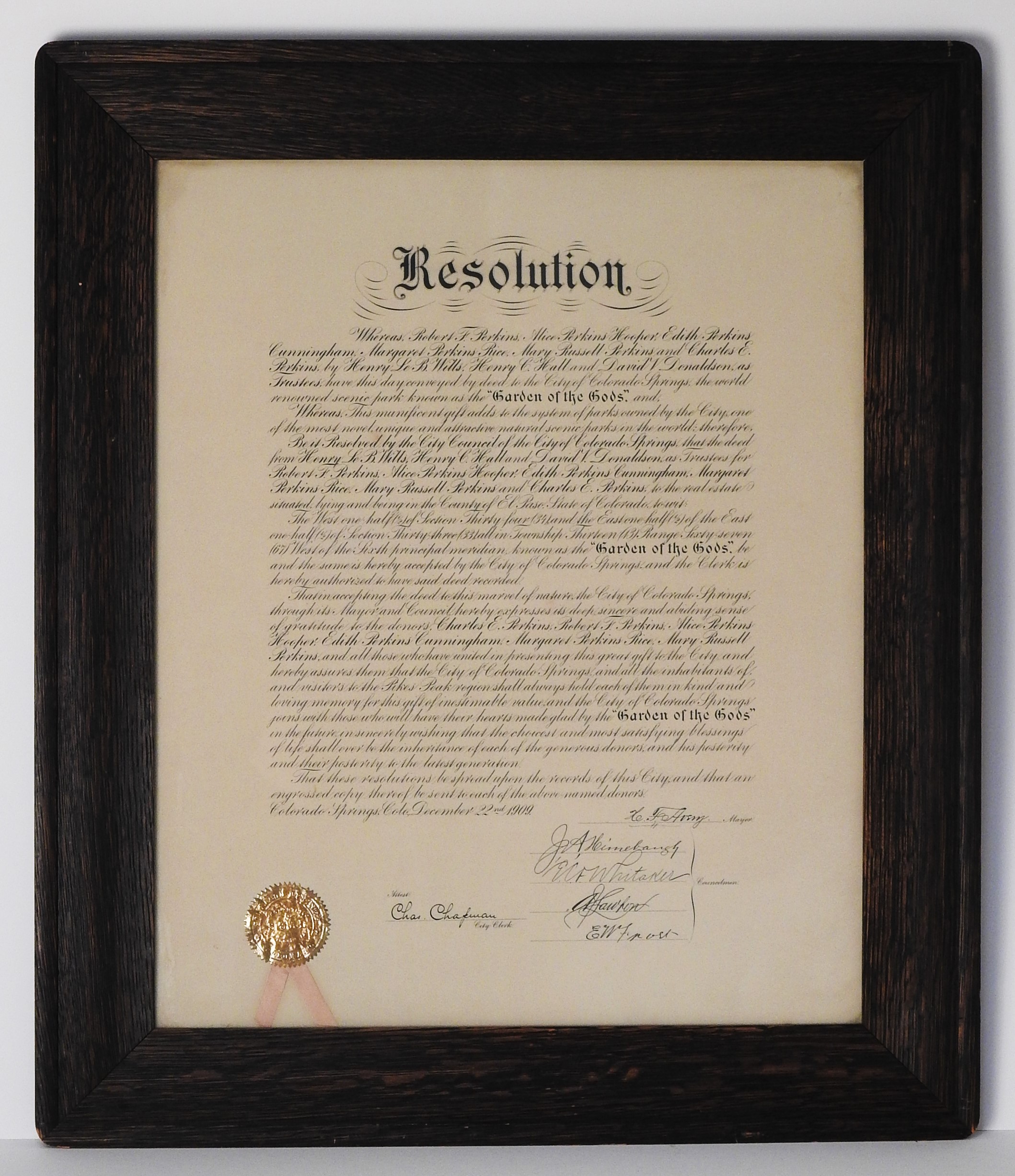
What led the Perkins Family to donate the Garden’s original 480 acres to the City of Colorado Springs? The answer is found in stories of friendship and of children fulfilling their father’s dream. In 1879, our City’s founder General William Jackson Palmer convinced his friend Charles Perkins to buy 480 acres of red rock spires known as the Garden of the Gods. A few years later, Perkins put into writing his intention to donate the Garden to the City, influenced by Palmer who had already donated over 1,000 acres of parkland.

Unfortunately, Perkins died before he had arranged for the Garden to become a public park. But Perkins’s four daughters and two sons, honoring their father’s wish, deeded the land of vertical red rocks to the City with the stipulation that it would remain “a free and public park forever.”

General Palmer and the Perkins Family were not the first to recognize that the Garden of the Gods should be a public park. Almost forgotten in our local history is that 23 years before the Garden became a City Park, it almost became our country’s second National Park. (Yellowstone was first.)

In 1886, a bill was introduced in the U.S. Congress proposing the Garden as a National Park to “protect the Garden of the Gods from spoilation.” However, the bill was defeated because too much land was privately owned within the proposed park boundary that would have included the Garden of the Gods, Manitou Springs, Cripple Creek and Pikes Peak with all its surrounding mountains and canyons.

However, the Garden of the Gods has been designated as a National Natural Landmark (1971) and is listed on the National Register of Historic Places (1979). In the National Landmark documents, the Garden is described as “the most striking contrast between plains and mountains in North America, with respect to biology, geology, climate and scenery.” The Park is a continental crossroads where native plants and animals converge from the grasslands of the Great Plains, the evergreen forests of the Rocky Mountains and the dry deserts of the American Southwest.

The Garden also holds many reminders of the region’s human history—ancient hearths, the centuries-old trail of the Nuu-ciu (Ute) American Indians and rock signatures of gold-seekers. Included within the Garden’s boundary is Rock Ledge Ranch Historic Site. This 230-acre site was placed on the National Register for Historic Places for its interpretation and restoration of historic buildings that tell the story of this region from the late 1700s to the early 1900s.

The daunting challenge for today’s and future citizens is to preserve the extraordinary Garden of the Gods Park. If each generation takes good care of the gift of the Garden of the Gods, then citizens and visitors from around the world will continue to enjoy the spectacular Park, and contemplate the beauty of its timeless views—red rocks etched against a bright blue sky with snow-capped Pikes Peak glistening in the distance.

Generously Submitted by Melissa Walker, Naturalist & Interpreter