
The CSPM is proud to celebrate Black History Month every February with special tours, programs, family activities, ongoing partnerships, and exhibits. Founded by historian Dr. Carter G. Woodson in 1926 as a week-long commemoration coinciding with the birthdays of Abraham Lincoln and Frederick Douglass, Dr. Woodson sought to acknowledge the historic contributions of African Americans to the nation. Importantly, 2026 marks the centennial anniversary of Dr. Woodson’s annual commemoration. Fifty years ago, during the Bicentennial celebration in 1976, President Gerald R. Ford issued a message recognizing Black History Month, urging Americans to “seize the opportunity to honor the too-often neglected accomplishments of Black Americans in every area of endeavor throughout our history.” Today, the celebration of Black History Month itself is an important part of our national, state, and local history.
Celebrate Black History Month 2026
At the CSPM, we are thrilled to share our newest exhibit, Fannie Mae Duncan: An Unforgettable Life & Legacy which includes an interesting array of Fannie Mae Duncan’s personal possessions including a few of her Austrian crystal perfume bottles and one of her stylish feathered hats. Additionally, the “world’s smallest band” is back on exhibit. This treasured artifact was actually an elaborate speaker system with miniature orchestra players who moved intime to the music played selected by patrons at a nearby jukebox. The exhibit is filled with quotes and stories from Fannie Mae Duncan herself, made possible through the brilliant work of Kay Esmiol, a renowned local educator and longtime friend of Fannie Mae Duncan. Esmiol lovingly cowrote, Everybody Welcome: A Memoir of Fannie Mae Duncan and the Cotton Club, and the book is essential to anyone interested in the fascinating story of the legendary Fannie Mae Duncan.
Plan Your Visit
Born July 5, 1918, in Luther, Oklahoma to parents Herbert and Mattie Bragg, Fannie Mae was the middle child, or as she said, “smack dab in the center of seven kids…two brothers and a sister before me, and two brothers and a sister after me.” The Braggs were successful tenant farmers until her father Herbert’s untimely death in 1926. Unable to manage the farm on her own, Mattie and her children left their home and moved to Guthrie, Oklahoma. On the night of their departure, their belonging piled high in the back of a truck, Fannie Mae described, “As Uncle Early drove away, I watched our house growing smaller in the distance…. The only home I’d ever known dissolved into the starless night. “Don’t look back, Fannie Mae, we gotta move on,” said Mattie. To help support the family Fannie Mae’s older sister Frances moved to Manitou Springs, and while living with relatives, sent her entire paycheck home to her mother. Eventually, Mattie and her younger six children fled Dust Bowl-Era Oklahoma and settled in Colorado Springs.
The Braggs were happy to leave the “hard times” behind when they arrived in the summer of 1933. As Fannie Mae described, “…we reached the outskirts of the city and got our first glimpse of Colorado Springs. We were almost speechless. It was beautiful. There were lights everywhere, and it wasn’t even Christmas. We couldn’t stop staring at the monstrous peak towering over the middle of the city like a protective giant.” Prior to their arrival, Frances rented the family a home at 704 North Franklin Street for $8 dollars a month. To their delight, the house had both electricity and indoor plumbing – a first for Mattie Bragg. As Fannie Mae recalled, “I’d always had a big imagination, but I was beginning to realize that life could take turns beyond my wildest dreams…We’d had us some hard times after Papa died, and the Depression didn’t make it any easier, but …things were definitely looking up for the Braggs. I had no idea what the future held, but one thing I knew for sure – Colorado was the place for ME!”
“I’d always had a big imagination, but I was beginning to realize that life could take turns beyond my wildest dreams…We’d had us some hard times after Papa died, and the Depression didn’t make it any easier, but …things were definitely looking up for the Braggs. I had no idea what the future held, but one thing I knew for sure – Colorado was the place for ME!”
Fannie Mae
The family eventually moved to a house on the city’s near-westside, in the heart of a historic African American neighborhood. Fannie Mae was a bright student who excelled at North Middle School and then Colorado Springs High School, now known as Palmer. In addition to helping at home, Fannie Mae worked as a waitress at Father Divine’s restaurant, and as a maid for Russian Count Benjamin Lefkowsky at his palatial home on North Cascade, now known as the Cascade Park Apartments. Fannie Mae graduated high school in 1938, but unable to afford her dream of attending Langston College, she went to work full-time as a maid for the family of District Attorney Irl Foard.
Family meant everything to the Braggs, and they flourished in their tightknit working-class neighborhood. Recalling later, Fannie Mae stated, “Generosity and kindness, ‘specially to kids, was almost a trademark on the Westside. The Holiness Church on Spruce Street was led by the very respected Reverend Chester Morgan, and the community reflected his dedicated and exemplary leadership….We had pride. Neighbors saw to it that everybody had clothes on their backs and shoes on their feet, even in the hardest times… I learned more than religion at Reverend Morgan’s Holiness Church. That’s probably why I was able to manage a restaurant without any training when I was still very young.” Unfortunately, the Bragg home and well over a hundred others were destroyed in the 1950s for the construction of the “Monument Valley Freeway,” now known as I-25.
Six years her senior, Ed Duncan proposed to Fannie Mae while she was still in high school, but they waited over a year after her graduation and were married by a justice of the peace in the El Paso County Courthouse on October 9, 1939. Ed worked as a cook for Mrs. D. Arthur Jones on Lake Avenue and Fannie Mae took a job working in the home of District Attorney Irl Foard. The Duncans bought their first home on Corona Street, then known as “the east side of town.” Fannie Mae took a job working for Mrs. Carolyn Jackson in the Broadmoor for $15.00 dollars a week, but in late 1941 the Jackson Family moved back to Chicago, and Fannie Mae Duncan was out of a job.
After the Japanese bombed Pearl Harbor on December 7, 1941, Congress voted to formally enter World War II. Almost immediately, construction of Camp Carson on the former Cheyenne Ranch six miles south of town began, with a $30 million dollar contract to build in just six months a “large Army cantonment” to house and train 30,000 soldiers. All told, 104,165 service members trained at Camp Carson during WWII. After the end of the Korean War, the post designation was upgraded to Fort Carson, and by 1956 the base was the single largest contributor to the Colorado Springs economy, employing 2,000 civilians.
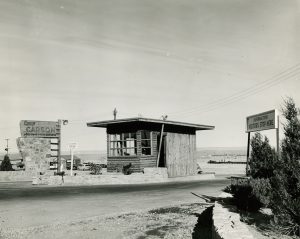
Camp Carson provided many civilian job opportunities for African Americans in Colorado Springs – among them Fannie Mae Duncan. Still in her early twenties, she passed the Civil Service test with a score of 99% and was hired as the soda fountain manager at the “Haven Club” for Black soldiers on post. Her supervisor, Johnny James gave her poignant advice, “The main thing to remember…is that the young men coming into your soda fountain are eventually going to war…Some who are going overseas won’t be coming back…So make them feel welcome… Make them feel at home.” She later reflected, “That really hit me, thinking about serving young men who might be facing death real soon…My goal was to make every soldier feel welcome, give him a little something to laugh about.”
As the war continued, Ed was rejected for military service due to hearing damage and took a job unloading baggage at the Santa Fe Depot. Meanwhile, Fannie Mae was earning daily profits of hundreds of dollars for the Haven Club on Camp Carson. However, she wanted more. Why should she make money for someone else? Why not be her own boss? When Fannie Mae learned of a new opportunity, she persistently lobbied City Manager Earl Mosely for a business license so she and Ed could operate the café for Black soldiers. She was just 26 years old. Once again, Fannie Mae Duncan was wildly successful with the USO café packed with customers until closing time.
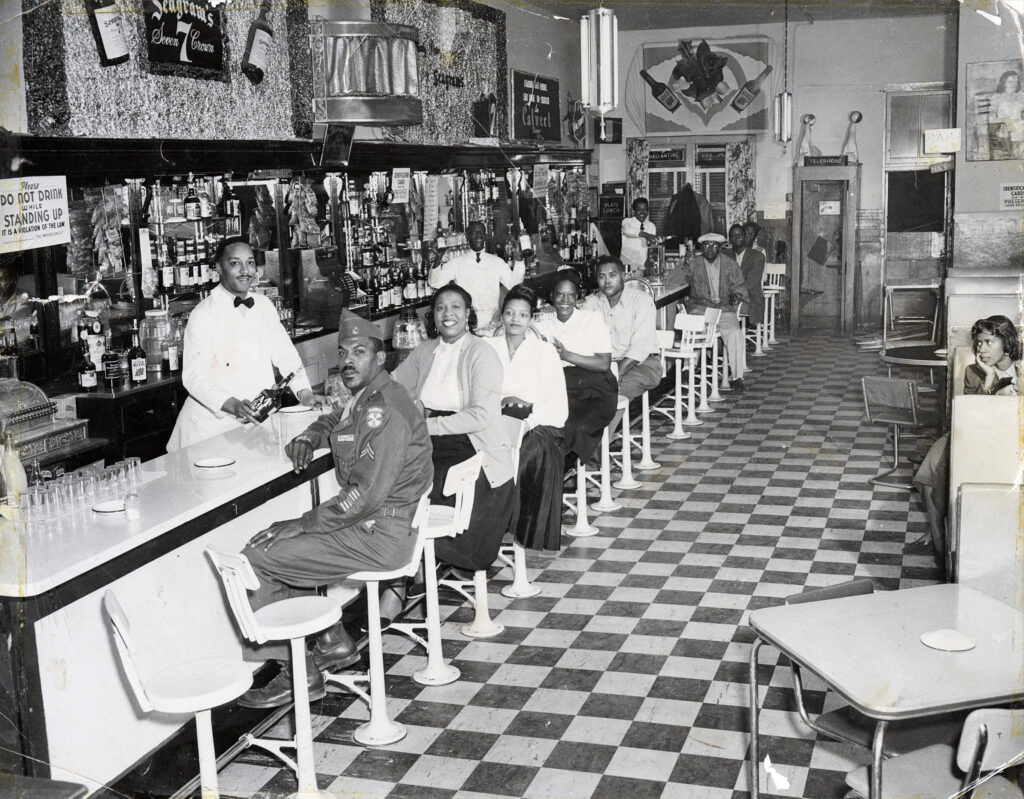
Finally, Fannie Mae Duncan learned of a much larger opportunity. Douglass Hall on Colorado Avenue was for sale. Acting fast before the existing liquor license expired, Fannie Mae and Ed borrowed $3,000 from Ed’s former employer, Mrs. D. Arthur Jones and added another $3,000 from their own savings for a downpayment. Now, they were business owners. After Duncan’s Café opened they added the Cherry Pit Barbeque along with a barbershop, shoeshine stand, beauty shop, record store, cigar store, gift shop and eventually Duncan’s Lounge. In other words – her own mall serving Black customers. Dreaming even bigger, the Duncans headed to the Rossonian nightclub in Denver’s Five Points neighborhood, where Fannie Mae pitched Ed her most ambitious idea yet – opening the Cotton Club — in Colorado Springs.
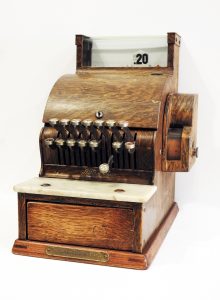
Cotton Club Cash Registrer, ca. 1950. Generously donated by Fannie Mae Duncan, 75-90-5. Currently on exhibit in COS@150: Colorado Springs’ Story Through Objects.
Transforming the floor above Duncan’s Café and Bar into the Cotton Club took tremendous effort. Every night after they closed the café, Fannie Mae and Ed went upstairs to work on the nightclub space. Taking a big risk when money was tight, Fannie Mae ordered a $4,300 dollar twenty-foot-high flamingo pink “Cotton Club” neon sign to hang outside. Perhaps even riskier was Fannie Mae’s business plan. Unlike the famous Cotton Club in New York which catered to, “…rich white folks getting entertained by Blacks. My Cotton Club was gonna be open especially for Black folks, and I planned to hire the top entertainers of the day for them, too.” Her business cards read: Easy to find. Hard to leave.
To attract first-class musical acts the Duncans purchased a $1,600 dollar Steinway piano, and Ed fixed the lighting, created a sound system, and built a band stand. Fannie Mae also created a dress policy, requiring all men to wear ties. If they didn’t arrive with a tie, Fannie Mae purchased ties at the Salvation Army that they could “rent” for a dollar. As she remembered, “I came up with the idea of a dress code because I thought it would increase the popularity of the club. I was also hoping that people would act as good as they looked. People loved being seen at the Cotton Club in all their finery.”
“It was a big surprise to me when the Cotton Club suddenly became a place where whites wanted to be.” Fannie Mae and Ed got a call to meet with Colorado Springs Police Chief Irvin B. “Dad” Bruce. He asked, “Is it true you have Blacks and whites and all colors mixing at your club? Fannie Mae replied, “They’re in there mixing. But they’re doing it on their own. I check them for age. Nobody told me I had to check them for color. White folks know their constitutional rights.” Dad Bruce insisted, and Fannie Mae left defeated. However, the next day Chief Bruce called and told her he changed his mind, “You’re doing a great job.”
Fannie Mae put a hand lettered “Everybody Welcome” sign in the window and it became the motto of the Cotton Club. And it turned out that everyone wanted to come because it was the only place in town where you could see legendary entertainers like Duke Ellington, Count Basie, Lionel Hampton, Etta James, and others. Talented local musicians like Fez Bryant were regular players and Fannie Mae gave comedian Flip Wilson his start when he was stationed at Fort Carson. In addition to her success as a businesswoman, Fannie Mae was noted for her philanthropy. She was one of the founders of the 400 Club, an organization that provided for those in need regardless of race or religion.
When Black entertainers or Black tourists traveling through Colorado Springs were denied accommodations at local hotels despite bans on illegal segregation, Duncan purchased the North Nevada Avenue Victorian mansion of Dr. James A. Hart. Saving the historic home from demolition, she paid a moving company over $6,000 to cut the mansion into three parts and relocate it to 615 North Corona. Fannie Mae operated her “new” home as a boarding house/hotel with delicious meals made from scratch by “Momma” Mattie Bragg. The only business failure for Fannie Mae was her purchase of the Iron Springs Chateau in Manitou. Denied a business license after locals protested, she never forgot the sting of racism and declared, “the people of Manitou Springs made it clear I was not welcome.”
For 28 years Fannie Mae Duncan graciously served the public, welcoming everyone who walked through her door. Unfortunately, Colorado Springs also turned its back on her. In 1975 using “eminent domain,” the Cotton Club was torn down under the Urban Renewal program. Fannie Mae was heartbroken. She oversaw the transition of her former mansion the Hart-Duncan home into a care facility for adults with mental illness, but soon after left Colorado Springs for good. Fannie Mae Duncan passed away on September 13, 2005.
Leah Davis Witherow, Curator of History
719.385.5649 | Leah.Witherow@coloradosprings.gov