1880 - 1889 Archives - CSPM

Lorem ipsum dolor sit amet, consectetur adipiscing elit. Ut elit tellus, luctus nec ullamcorper mattis, pulvinar dapibus leo.

Charles Aiken

The 21-year-old Charles Edward Howard Aiken already had a longstanding interest in birds and had been apprenticed to a taxidermist before moving to the Pikes Peak region in October 1871. In the aftermath of the Great Chicago Fire, which destroyed the family home and business, the Aikens bought a sheep ranch near Turkey Creek along present-day Colorado Highway 115, about 20 miles south of Colorado Springs.

By exploring birds wherever he roamed, Aiken gained deep insights into the avifauna from the Midwest to the Southwest. In the first year of his Colorado residence, he encountered 115 different local species which he described in an 1872 paper co-authored with Charlie Holden for the Proceedings of the Boston Society of Natural History. Two years later, having garnered a reputation as a regional authority, he served as assistant ornithologist on the governmental Wheeler Survey along the Colorado-New Mexico border and most of his skillfully prepared taxidermy specimens from this expedition were sold to the Smithsonian. Forays into different parts of Colorado, New Mexico, and Arizona resulted in two additional publications: The Birds of El Paso County (1914), and Birds of the Southwest (1937, appeared posthumously). The former was co-authored, the latter edited by fellow ornithologist and Colorado Springs resident, Edward R. Warren.

By 1907, Aiken’s bird collection numbering 4,700 specimens was acquired by General William Jackson Palmer and donated to Colorado College, where he had secured a professorship for noted British ornithologist William Lutley Sclater, husband to one of Queen Palmer’s half-sisters. Sclater’s personal survey of the regional avian population and of Aiken’s prodigious collection, brought about the 1912 publication of the two-volume A History of the Birds of Colorado.

Charles ran the “Aiken Museum” in downtown Colorado Springs, a combination taxidermy and curiosity shop, and though his fascination with winged creatures never waned, his later interests included paleontology, evolution, and dog breeding, among others. A great honor was bestowed on Charles when the prestigious American Ornithologists’ Union, precursor to the American Ornithological Society, made him “Life Associate” at age 76, after he had allowed his membership to lapse. He lived to 85 and was buried at Evergreen Cemetery.

The tributes did not end with his death. A Nature Conservancy preserve, Aiken Canyon, was established in 1993 in an area Charles had explored as a young man from the nearby family ranch. It remains one of El Paso County’s top birding hotspots. The Aiken Audubon Society of the Pikes Peak region commemorates not only his name, but its logo “Wes” is modeled on the regional subspecies of a Western Screech Owl named for Aiken, Megascops kennicottii aikeni.

Generously Submitted by Tanja Britton, CSPM Volunteer Educator

Colorado Springs Opera House

With profits from their mining ventures in Leadville, early city residents Irving Howbert, Benjamin Crowell, and J.F. Humphrey built the Colorado Springs Opera House at 18 North Tejon Street in 1881. Architect A.C. Willard modeled the interior after New York’s Madison Square Theatre. The building was red brick with black mortar, with cut sandstone adornments from Cañon City, three stories tall.

The first half of the building, adjacent to Tejon Street, had offices on the second floor, and a Masonic Lodge and banquet room on the third floor. In the 55-foot-wide ground floor were two 20-foot-wide stores on the building’s two sides, with a twelve-foot entrance in the center leading down a hallway to the lobby and theater in the back of the building. The spacious entrance was of white live oak arches.

The theater seated 800, with balcony and private boxes, and the auditorium was originally lighted with over 261 gas jets, plus a chandelier of 52 burners, all focused on a 55’x30’ stage. The building cost $80,000 and many thought it could not be surpassed west of the Mississippi.

Opening night was April 18, 1881, with a sold-out feature of “Camille,” from the Alexandre Dumas novel that also became the opera “La Traviata.” This was the largest audience to ever assemble inside any building in the city at the time. In the finale, Camille, played by Maude Granger, tragically dies, likely from tuberculosis, a fitting but troubling event given the large number of residents who came to Colorado Springs to recover from the disease.

The theater ran about 34 productions per year and included such notable entertainers as Lon Chaney and Oscar Wilde. The Opera House was also the scene of a murder and “riot” between factions of the Republican Party in 1898.
After the even more opulent Burns Theater opened in 1912, the Opera House lost its stature. It converted to a movie theater in 1919, then in 1947 the third story was removed, the front façade changed, and the building remodeled into a Woolworth store with a popular lunch counter. Woolworth closed in 1989, and after a briefly vacancy it became a night club complex, currently named the Mansions dance club that occupies the old auditorium of the Opera House.

Generously Submitted by Dr. John Harner, Professor of Geography & Environmental Studies, University of Colorado, Colorado Springs

Cheyenne Cañon

The original 1885 North Cheyenne Cañon Park grew by 480 acres thanks to a 1907 donation by city founder, General William Jackson Palmer. If it hadn’t been for his vision, which included the preservation of the beautiful scenery and the provision of public parks, residents and visitors would have fewer open spaces for our enjoyment and edification. Colorado Springs voters supported this vision in many, but not all instances, which is why today you can visit North Cheyenne Cañon for free, but have to pay a fee to enter its neighbor, South Cheyenne Cañon.

Both canyons are named for creeks, both creeks form waterfalls, and both waterfalls have a connection to famous author and American-Indian activist, Helen Hunt, a Colorado Springs resident from 1873 until her premature death in 1885 at age 54. Not only did her writing sing the praises of Colorado Springs in general, she loved Cheyenne Mountain and its canyons in particular, and, like many locals, made frequent excursions to the area with horse and buggy, to enjoy the magnificent landscape, vegetation, and cool mountain streams. The Helen Hunt Falls in North Cheyenne Cañon bear her name, and South Cheyenne Cañon once bore her burial site, though her remains have since then been relocated to Evergreen Cemetery.

Both Cheyenne Cañons have always been popular destinations for hikers and sightseers alike, and shops selling souvenirs have existed at both locations since the early days of tourism. Colorado College, North Cheyenne Cañon’s first owner, built The Bruin Inn as a retreat, as well as a smaller building, known as The Cub. Located adjacent to Helen Hunt Falls, this was repurposed into a visitor center once the area became a public park. Its successor opened in 2013.

South Cheyenne Creek tumbles down a narrow box canyon, 191 feet in seven separate, picturesque falls. A 224-step staircase parallels the cascading waters and leads to an observation platform as well as forested plateau with several hiking trails. They are also accessible via a 170-foot elevator whose shaft was drilled through solid rock by the family of Al Hill, the penultimate owners, whose daughter, Lyda Hill, is a major benefactor of Garden of the Gods. The Seven Falls property changed hands several times, until it was purchased by The Broadmoor, following the devastating 2013 flood which necessitated major repairs. Guests find gift shops, a creek-side restaurant, and zip-lines.

Generously Submitted by Tanja Britton, CSPM Volunteer Educator

Midland Railway

Incorporated in 1883, the Colorado Midland Railway was run by James J. Hagerman, a wealthy mining investor who moved to Colorado Springs in 1884 from Milwaukee to recover from tuberculosis. Hagerman owned silver mines in Aspen and coal deposits near Glenwood Springs. He steered the company to connect Colorado Springs to these mines.

The railroad based its roundhouse and repair yards in Colorado City at what today is Highway 24 and 21st Streets and built their line west up Ute Pass. The company’s massive investment revived the moribund Colorado City. The goal was to first connect to Leadville then cross the continental divide to Aspen.

The Midland reached Leadville on August 31, 1887, then went west through the 2100’ long Hagerman tunnel, 547’ beneath Hagerman Pass, after which the line continued along the Frying Pan River. The 2.9 mile-long Busk-Ivanhoe Tunnel was built in December, 1893, to supersede the Hagerman Tunnel and reduce the long climb over the Continental Divide. The line reached Aspen in February, 1888.

By 1890 the Midland was competitive, with two daily passenger trains from Colorado Springs. The railroad made money on freight, particularly coal and coke from New Castle and Cardiff. Coal was delivered to consumers in Aspen, Leadville, Colorado Springs, Denver, and Pueblo, and coke was sent to smelters in Leadville & other smaller locations. The company also moved much timber, but relied principally on livestock, with loading points peaking during autumn at Rifle and Hartsel, and sheep from Utah brought for summer grazing near Aspen and Hagerman Pass.

The Colorado Midland also prospered from tourism out of Colorado Springs, with regular service into the mountains for picnics and wildflower collecting. Midland tracks extended east to connect with the AT&SF passenger terminal on Pikes Peak Avenue in 1887. The Colorado Midland dissolved May 21, 1922 and rails were torn up for reuse along most of its route, but service continued with an offshoot company, the Midland Terminal Railway.

Incorporated in 1892, this line began as a 31-mile spur connecting Colorado Springs to the gold mining camp at Cripple Creek through Divide. The Midland Terminal continued service between Colorado Springs and Cripple Creek until 1949. Highway 24—“the Midland Expressway”—was built in the late 1950s and now runs along the old train route. The roundhouse remains, retrofitted into restaurants and shops, and the Hagerman building still stands on Tejon Street.

Generously Submitted by Dr. John Harner, Professor of Geography & Environmental Studies, University of Colorado, Colorado Springs

Pikes Peak Signal Station

In 1873 the United States Army built the first structure on Pikes Peak’s summit, a Signal Corps’ weather station. It was constructed of the stone available at hand. It was torn down and replaced with a larger building in 1882. It was the year-round quarters for two Observers and their equipment. Unexpectedly it also served as shelter for summit visitors who were unprepared for the altitude and cold. Its use was discontinued around 1888. That year a carriage road from the Town of Cascade reached the summit, providing tourists an alternative to hiking or riding horseback.

Zalmon Simmons financed the construction of a cog railway from Manitou to the summit. The Cog took over the Signal Station for its upper terminal in 1891. They enlarged the building several times and added a steel observation tower. Inside there was a restaurant, souvenir sales, a telegraph office and accommodations for overnight guests.

Unable to purchase the Cog In 1915, Spencer Penrose improved the carriage road for automobile travel. To provide a restaurant and souvenir sales for his highway customers he built a Highway Summit House of cast concrete in 1917. The building was doubled in size around 1920. The highway hurt the Cog’s business and in 1925 Simmons sold the Cog to Penrose. In 1936 Penrose turned over the highway and the highway summit house to the Forest Service.

The Stewart brothers, Orie and Benjamin, managed the highway summit house. In 1938 they remodeled it, adding a second story and a “Crow’s Nest” using concrete block construction. The building was destroyed by fire in 1953.

In 1948 the City of Colorado Springs took over the highway and was given the task of building a new summit house to serve both automobile and Cog visitors. The new building was a steel frame structure with pre-cast concrete panels. It was finished in 1964 and by the end of that year a corner had sunk six inches into the melting permafrost. Several efforts were made to stabilize the building, and by 1995 forty jacks had been installed under the floor for that purpose. The old stone summit house was demolished, except for a short section.

In 1975 “The Plant” was constructed to provide relief for the overcrowding of the 1964 building and to house a sewage treatment plant. The roof of this building was an observation deck.

In 2021 a brand new – state of the art – LEED certified building will open as the new Pikes Peak Summit House. This ambitious project will offer viewing platforms, interpretive exhibits, food services, retail space, expanded comfort facilities – and of course the “world famous” Pikes Peak donuts.

Generously Submitted by Eric Swab, Historian

Broadmoor

The piedmont below Cheyenne Mountain, just south of town, became known as the Broadmoor. Early irrigators tapped into Cheyenne Creek, building ditches and reservoirs for agriculture. The Broadmoor Dairy was a large operation that provided fresh milk and cream to regional residents and tuberculosis sanatorium patients for many years. Owner Count James Pourtales, a Prussian diplomat who arrived in 1885, formed the Cheyenne Lake, Land, and Improvement Company, built a new reservoir, and divided the land into large lots.

Several wealthy residents built the Cheyenne Mountain Country Club, formally organized in 1891, on one of these lots, with tennis, golf, and horses as amenities, but the polo field became its most famous diversion. Count Pourtales built a casino that opened also in 1891, beyond the city limits and its restrictive ordinances. Offering live music, cocktails, and gambling, he intended a palace of refined pleasure to complement the nearby country club.

Pourtales sold his Broadmoor land holdings to the estate of Winfield Scott Stratton to fund and build the Myron Stratton Home for the indigent. Most Stratton properties were sold to wealthy mining magnate Spencer Penrose’s Broadmoor Land Investment Company in 1916, including the 450 acres with lake and casino. Living with wife Julie in El Pomar, a Mission Revival villa west of the country club, Penrose announced he would build a new Broadmoor resort.

The Mediterranean-themed, pink stucco building with red tile roofs opened June 29, 1918, exquisitely decorated throughout and hosting 350 guest rooms. The Penroses spared no expense, with full-service shops, fine art, a front entrance and grounds designed by the famous Olmsted landscape architectural firm, and hosting the best golf course in the West. It was a playground for the wealthy, and the hub from which Penrose built complementary companies.

Throughout the years he added a rodeo and race track, more polo fields, a world-famous ice arena, and increasingly more golf courses. He also developed events and programs to serve as a sports hub, contributing to the reputation for Colorado Springs as an amateur athletics node.

The company built the Rosemont Reservoir in 1932 on the south slope of Pikes Peak, giving the resort dependable water via a new 13-mile pipeline. The residential area that grew up around the Broadmoor maintained independence until 1973, when the city purchased the Broadmoor water rights and facilities. The area was formally annexed into city in 1980.

Generously Submitted by Dr. John Harner, Professor of Geography & Environmental Studies, University of Colorado, Colorado Springs

Colorado Springs Police Department

After the incorporation of the Town of Colorado Springs, 02 Sep 1872, town trustees appointed its first law enforcement officer, Smith C. Foote. A space was rented for the town government at 122 East Huerfano Street (Colorado Avenue today). The first election was held the following May and Commodore Perry Downing was the first elected Constable. Election were held every year. Constables did not get paid, city trustees said “they were satisfied . . . Officer’s commissions as Collector of Taxes, fees for services . . . obviate the necessity of making any appropriation . . . towards his Salary.”

In 1875 the new city hall at 118 South Nevada Avenue that contained the fire department as well as the constable opened. 04 Mar 1878, an election was held and the incorporation of the City of Colorado Springs and with this change came the law officers now being Marshal’s, who would have police officers under their command. 30 Apr 1888, Horace Shelby, a minority officer was appointed. By 1900 the number of officers had grown from the original 1 to 12. 28 Jun 1896, Officer Benjamin Franklin Bish, while attempting to arrest two burglary suspects, was shot and killed.

Under state law, the 1900 U.S. Census figures qualified Colorado Springs to have a police department. On 15 April. 1901, Vincent King was appointed the first police chief and he had 19 officers. By 1910, the department had 27 officers, a police chief and its first sergeant rank.

In June 1910 a motorcycle was purchased to catch speeders. In 1914 two vehicles were added to the department. In mid 1915, Georgia Easley became the first social investigator for CSPD. December 1935 Deputy Chief Boatright attended the FBI Academy. During 1937 a 3-wheel Harley Davidson motorcycle was purchased for meter patrol. March 1941 the first 2-way radio was installed, call sign KPCS. In 1954 radar was purchased to detect speeders and an alcometer to test for DUI.

In 1966 the first female police officer was hired, Charlotte Mahan. She went on to be the first female sergeant, lieutenant, captain and was the first female to be retired as a police officer. In 1974 a Bell 47 helicopter was put into service. In 1977 a police reserve program began with 35 people. A pastor corps was added to assist officers with people.

In November 1990, uniformed police officers acquired body armor. During 1991, CSPD became nationally accredited. In 1994, CSPD moved to their current location along with four substations. Colorado Springs grew from a population in 1900 of 21,000 and 14 officers, to a current population 486,000 and 739 officers (621 men & 118 women).

Generously Submitted by Dwight Haverkorn, Colorado Springs Native, Former Investigator, CSPD Historian

Jefferson Davis Family

Joel Addison Hayes, his wife Margaret Davis Hayes, and their children arrived in Colorado Springs in 1885 from Memphis Tennessee. Margaret was the daughter of Jefferson Davis. Neither she nor her husband had any connection to Colorado Springs. It was chosen, perhaps due to a letter from Jefferson Davis to his wife Varina when he visited in 1875. He wrote that she would enjoy the beautiful flowers. Joel’s health issues brought him to seek the clean air of Colorado. He brought a letter of introduction from his former bank in Memphis and was hired by the First National Bank. It was an entry level position that would eventually lead him all the way to the top – as President of the Bank.

When they arrived in 1885, the couple had three children: Varina, Lucinda and Jefferson. Son William was born in Colorado Springs in 1889. Margaret focused on two things; her husband and children, and her father’s legacy after his death in 1889. At the funeral of her father, the Hayes family joined Jefferson’s widow, Varina Davis. They agreed that the name Davis needed to continue. They asked young Jefferson Addison Hayes to change his name. At the tender age of 6, his name was changed to Jefferson Hayes-Davis.

A man of great energy, Joel Addison Hayes had a tremendous impact on Colorado Springs – and one that still continues today. He was one of the founders of Glockner Hospital, now called Penrose. He also helped in the incorporation of The Colorado College Land Company, which created the campus of Colorado College that you see today. He became a financial advisor for both the Penrose and the Tutt families. He was among the first members of the El Paso Club and the Cheyenne Mountain Country Club. When gold was discovered in Cripple Creek in 1891, Joel became the banker for the miners. Most of these were tradesman with no family. Hayes created trusts that provided resources that still benefit Colorado Springs today. His banking leadership led to the creation of the Colorado Bankers Association.

Margaret died in 1906 of cancer. Joel would live until 1919. The four children all married in Colorado Springs. Many of the historic names of Colorado Springs are associated with the Hayes family, including Hayes-Davis, Webb, Sinton Dairy, the Collins family and Varina Hayes Bennet Stewart. Many Davis Family relatives still make their home in Colorado Springs, and continue to contribute to the community.

Generously Submitted by Bertram Hayes Davis, Davis Family Historian

Sinton Dairy

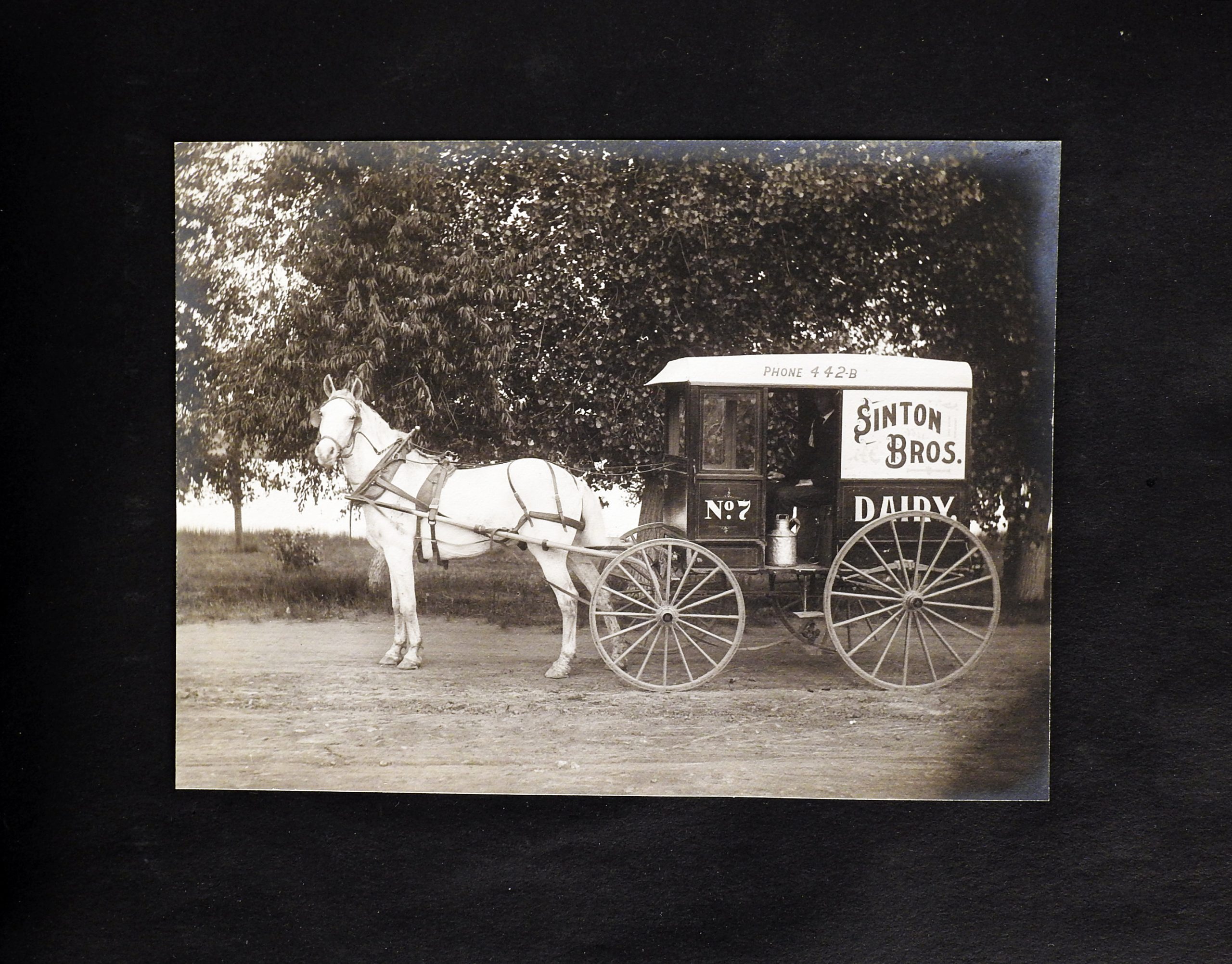
Melvin Sinton started the Sinton Dairy in 1880 and was soon joined by his brother George. They started with twelve red cows to produce fourteen quarts of milk costing 10 cents delivered daily with a horse-drawn wagon. Their first barn was built near the corner of East Willamette Avenue and North Corona Street in the Shooks Run floodplain, where the cows could graze in the lowlands and access the creek for water.

Shooks Run flooded in 1885 so the brothers moved the dairy headquarters to 419 South El Paso Street in 1887. They leased a barn near Prospect Lake (built in 1890), and the area around their headquarters, barn, and cattle pastures that today is known as the Hillside Neighborhood was called Sinton’s Hill.

The company incorporated in 1906 and introduced pasteurized milk to Colorado Springs in 1907. As the company grew, it bought the Holland Dairy farm in 1924 north of town, leased land near what is today Peterson Air Force Base, then in 1928 bought two ranches in Stratmoor Valley along Fountain Creek south of the city. In 1937 trucks replaced the horse-drawn wagons, then the company moved to a new plant built in 1955 north of the city, on what is now Sinton Road. By the 1980 Sinton Dairy was the state’s largest independent maker of dairy products.

Both founder Melvin and his nephew Herbert, who took over company operations, served on City Council. Melvin also served as an El Paso County Commissioner and through his work with the El Paso County Pioneers Association was central to establishing the Pioneers Museum in 1937. The dairy made a lasting contribution to Colorado Springs, but its legacy has faded with time. Part of the Stratmoor Valley ranches were turned over to Fort Carson in 1941, other lands were converted into a regional park in 1973.

The company was sold to Associated Grocers in 1980. The Dairy Farmers of America cooperative and Sinton’s management bought Sinton after Associated Grocers filed for bankruptcy in 1987, then in 2009 the firm was acquired in by the Mexican conglomerate Lala. As part of the shift to producing ultra-pasteurized milk with a long shelf life, Lala replaced the Sinton name with Promised Land Dairy in 2016. Many citizens will fondly remember growing up with Sinton’s milk and Sinton Road remains a lasting reminder of the company’s influence on the city.

Generously Submitted by Dr. John Harner, Professor of Geography & Environmental Studies, University of Colorado, Colorado Springs