

Greens and Golds Streaming, Barbara Dimond, Mixed Media Collage
Exhibit Wall: Wall 6
“Nocturn”, Lucille Damico

Nocturn, Lucille Damico, Mixed Media Collage
“Untitled”, Eva Marie Schubart

Untitled, Eva Marie Schubart, Watercolor and Ink on Paper
“Untitled”, Heidi Brandt

Untitled, Heidi Brandt, Watercolor on Paper
Artist Biography
Born in Great Falls, Montana, Heidi Brandt Was educated in Seattle, focusing on commercial art: advertising, industrial design, greeting cards, and illustrations, including a children’s book published in 1946. She worked in charcoal, gouache, stone, watercolor, and woodcuts, as well as photography.
In 1954 and 1961, Brandt won the annual TB Christmas seal design award. In 1956 she was awarded a Fulbright Fellowship for a year’s study in Germany at the Stuttgart Art Academy. She studied and exhibited her work in Mexico as well.
From 1947 to 1966, Brandt lived in Colorado Springs with husband Thomas Brandt, a professor of German at Colorado College. She collaborated with Thomas on his book of short poems, published in 1960, that speak of love, nature, and everyday subjects. Her accompanying small black and white woodcuts depict trees, plants, mountains, birds, female nudes, and other images, presented in mid-20th-century modern style. During this period, she designed Christmas cards for LooArt stationers in Colorado Springs.
Denver Public Library’s arts holdings include a watercolor on paper: “Portrait of a Young Black Boy,” dated from the 1950s. The Colorado Springs Pioneers Museum includes an untitled Brandt watercolor of a young woman in its exhibit, “Women Expressing Creativity.”
“Untitled”, Hazel Abbot
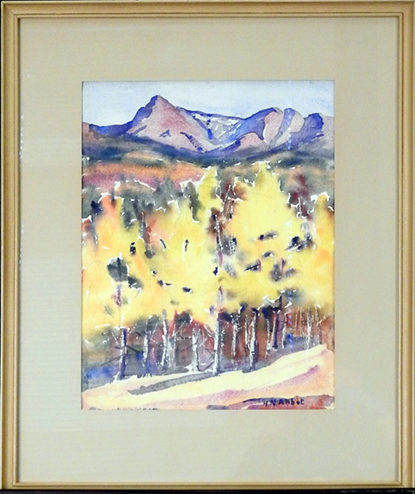
Untitled, Hazel Abbot, Watercolor on Paper
Artist Biography
Hazel Abbot, born on October 31, 1894, lived until 1903 at a Hudson Bay Company post called Moose Factory, Ontario, and later at Prince Albert, Saskatchewan, where her father was an Anglican bishop. In 1917 she immigrated to the United States to take a four-year course at the Child-Walker School of Fine Arts in Boston. She also attended the Charles Woodbury Summer School of Painting in Ogunquit, ME.
In 1923, the artist, recently married to Charles Abbot, suffered a breakdown, and despite several moves including five years in Colorado Springs, it wasn’t until 1933 when she regained her health and the desire to paint. Captivated by the scenic beauty around her, she began to paint Colorado landscapes. Soon she broadened her area of view to surrounding states of New Mexico, Wyoming, California, Oregon, and Vancouver Island, BC.
Exhibitions of her work came in the 1930s, with a show at Wellesley College, MA where she included pictures entitled Raton Pass, Cheyenne Canon, and Rampart Range, Colorado. In 1940 she had her first one-person show, held at the Colorado Springs Fine Arts Center. Group exhibitions included the Royal Institute Galleries and Royal Society of British Artists, London; Royal Scottish Academy, Edinburgh; and Society des Artistes Francaise, Paris.
The Colorado Springs Pioneers Museum, which held a retrospective show of Abbot’s work in 1986, owns several of her watercolors.
Hazel died on April 23, 1984.
“The Mile”, Lilly Parsons

The Mile, performed by Lilly Parsons
Artist Statement
Dance has been used for storytelling globally for centuries. From rituals to ballets, communicating via movement comes naturally. In my work “I talk with my hands—her hands,” I wanted to honor the women artists in my own family. Many women in my matriarchal lineage worked with forms requiring dexterity and detail, such as embroidery and cross-stitch, sewing, collage, baking, etc. My mind then went to their strong and gentle hands, so I chose to draw focus to my hands and fingers in choreography. It emphasizes the detail and intricacies of their art. I have always been attracted to the smallness and specificity of gesture—so much can be said with minimal movement. I enter the creative process with a story I’d like to tell and gather a few distinct movement that I feel are representative of this story. Then, I can build outward from this base gesture story into fuller movement. Gesture and “body language” appear in daily life, so using it in performance is accessible and understandable to an audience. This is not to say that there is necessarily an easily interpretable narrative, but that hopefully I express and honor the stories of the women who came before me and the beautiful things they created with their own hands.