Wall 10 Archives - Page 2 of 2 - CSPM

Lorem ipsum dolor sit amet, consectetur adipiscing elit. Ut elit tellus, luctus nec ullamcorper mattis, pulvinar dapibus leo.

“Snowy Day Power Plant”, Kay Jeansonne

Snowy Day Power Plant, Kay Jeansonne, Oil on Canvas

Artist Biography 

Kay was born in south Louisiana. Her journey into art started early, watching her dad draw and paint. With supportive parents who would supply her with any art supplies she wanted or needed, she was on her way. Early on she copied Disney characters and Norman Rockwell paintings, which led her to drawing from her own imagination.

She received a Bachelor of Fine Arts Degree from Louisiana State University as well as a Master of Education from Louisiana University. In moving to Colorado in 1995, Jeansonne said, “I wanted to paint where it is beautiful. I love the mountains, the sky, the colors and the variety of landscapes here. And I like the distances, from the mountains to the deserts.” For the next 18 years Kay studied with Carolyn Anderson, Eric Bransby, Chuck Mardosz, and Matt Smith, which helped her direct her works. She began showing her paintings in galleries in Denver, Colorado Springs, and Santa Fe, among other cities.

In 2002, she founded the Cottonwood Center for the Arts in Colorado Springs. “Cottonwood” is now housed in a 40,000 square foot building, with 75 artist studios, two art galleries, and the Cottonwood Artists’ School. During that time, Kay estimated that about 40% of her time was dedicated to painting. Now, it is 90%. “It’s always been my goal to paint full time”, and she is near that. She adds “I like to paint at night”, and with a studio in her westside home, as well as in “Cottonwood”, she can do that.
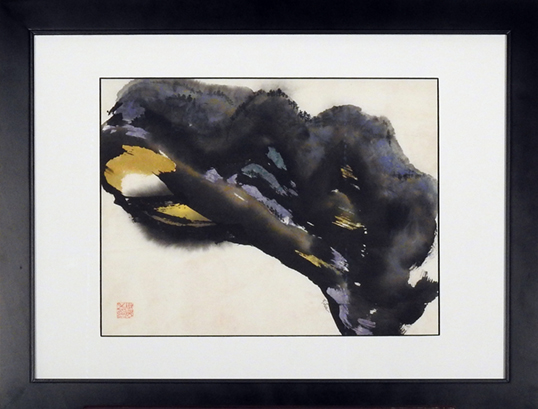
“Purple Mountain Majesty II”, Kang Lee Sheppard 

Purple Mountain Majesty II, Kang Lee Sheppard, Sumi Ink on Rice Paper

Artist Statement 

I came to Colorado Springs in the spring of 1967 to study western art. After receiving my BFA degree in Asian Art in Korea, my dream was to extend my art knowledge by pursuing graduate studies in the US. I had been trained in the Eastern tradition to create appearance in aesthetic and pursue infinity expression and I wanted to infuse that with Western artistic expression.

In Asian art, white negative space reflects the implicit and introverted characteristics of Asian painting. On rice paper, I grind my own black ink (called Sumie – Japanese, Muk – Korean) and use only natural colors from Korea to mix and create our beautiful Colorado Rocky Mountains in pursuit of my own art style.

In the past thirty years, I have volunteered to teach free classes to help our city’s art society and for it to grow. I am the founder of The Sheppard art institute.

“Untitled”, Charlotte Leaming

Untitled, Charlotte Leaming, Oil on Board

Artist Biography

Charlotte Leaming was born in Chicago in 1871 and made a name for herself as a painter of animals. Charlotte found many of her subjects in the Lincoln Park Zoo, as well as farms in the countryside. Later, Charlotte purchased a ram and a sheep and a cow, which she housed in her basement studio in downtown Chicago.

In May 1901 the Chicago Daily Tribune reported that “The residents of Lake Avenue near Fortieth Street, saw a tall, slender young woman in a painting apron, brilliant as Joseph’s coat, running madly down the middle of the street after two sheep. Paint brushes in one hand, palette in the other, she ran for two blocks, then transferring the brushes to the hand that held the palette, she made a final dash and clutched the ram’s wooly back. After that it was a mere matter of tugging and persuasion to get both of the mild-eyed animals back to the studio, especially adapted to the work to which the painter of animals devotes her time.”

Charlotte loved telling the story of an old farmer who visited the Chicago Art Institute when she was copying “Millet’s New Born Calf.” After watching her for a time, the farmer asked, “How much ‘ll you git for that ?” After she named the price, he pointed to the original and inquired, “how high will that come frame and all?” When told its value of many hundreds of dollars, he said scornfully, “the calf in your’n is lots more like calves than the other’n in the frame!”

Charlotte studied at the Art Institute of Chicago and took classes with Willian Chase and Albert Herter in New York as well as Frank Duveneck in Cincinnati. Charlotte taught at the Art Institute of Chicago from 1898 through 1905. She was an art supervisor at the Oak Park schools and taught at the Chicago Academy of Fine Arts in the early 1900s.

Charlotte moved to Colorado Springs, joining her sister Susan in establishing the Academy of Fine Arts in 1911. In 1917 the Academy joined with Colorado College, and Charlotte taught for many years at Colorado College with the title of Professor of Art Appreciation and Art History, until her retirement in 1940.  She was associated for years with the Broadmoor Art Academy. Charlotte passed away on January 4, 1972 at the age of 100.


“Mount of the Holy Cross”, Helen Chain 

Mount of the Holy Cross, Helen Chain, Oil on Board

Artist Biography

Helen was born in Indianapolis, Indiana on July 31, 1849. Following a family move to California, upon the death of her mother, she moved back to Indiana to live with a maternal aunt. Helen, nicknamed “Trot” for her love of travel, graduated from Illinois Female College (now MacMurray College) in 1869 with a major in English and formal training in art. Two years later she married James Albert Chain, and they settled in Denver where he established a book and stationery store. Helen began earnest work in her artistic style while also teaching art.

Helen was best known as a painter of mountain landscapes, traveling to the specific sites to paint. She was known as an avid mountain climber, taking in Pikes Peak, Grey, and Long’s peaks. She was reported to have been the first woman to climb and sketch Colorado’s Mount of the Holy Cross, in 1877. She sketched in Yosemite, the Grand Canyon, Yellowstone, Taos, and in Mexico. Typical works in the west were “Twin Lakes near Leadville”, “Royal Gorge on the Arkansas River”, and “Santa Clara Plaza”. She also illustrated John Dyer’s book “Snow-Shoe Itinerant”, published in 1891.

Helen was happy with her work, opening her studio to visitors and giving public exhibitions of her work to encourage others to take up the art. She exhibited in the Denver Art League’s first exhibition in 1892 and at the National Mining Exposition in 1893. She made a hit at the Minneapolis Industrial Exposition, displaying her “Mount of the Holy Cross”.

Helen and husband James were lost in the China Sea during a typhoon on October 10, 1892, while on a “two-year-round the world tour”. Her works are in collections at the Denver Public Library, State Historical Society of Colorado, University of Colorado, Boulder; Rockwell-Corning Museum, Corning, New York, and the Colorado Springs Pioneers Museum in Colorado Springs, Colorado.

“Monologue from Every Brilliant Thing”, Lynne Hastings

Monologue from Every Brilliant Thing, Lynne Hastings

Artist Statement
Why I am artist now is so different from when I started and, ultimately, decided to be an artist living in Colorado Springs.

Back then, I embraced theatre not only as a creative form of expression, but also as a way to be part of a community. I found a place in the theatre community here, which gave me the professional and personal opportunities that I was searching for in my life at that time.

Now, I am an artist because I want to tell (and hear) a variety of stories, especially from underrepresented communities. I don’t always have to be the storyteller. I just need to be an artistic ally who advocates for the stories that deserve to be told, but tradtionally haven’t. Everyone should have a seat at the table, and I do my part to make that possible through my work on and off stage.