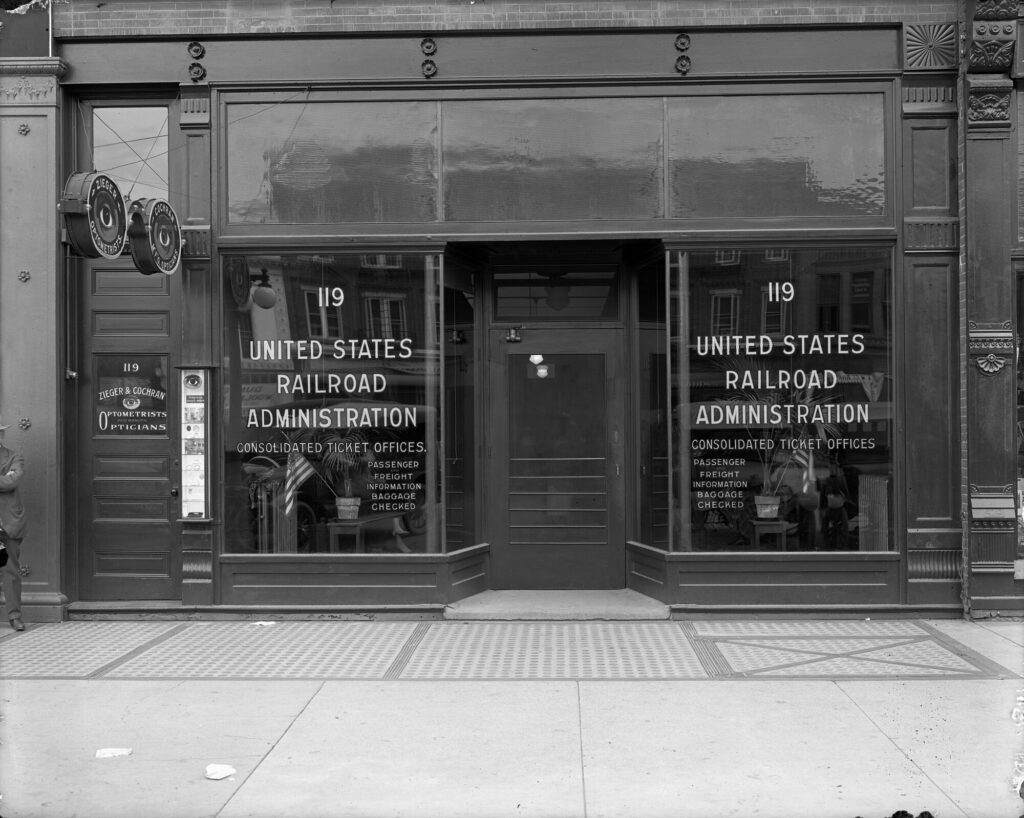
What’s in a photograph? As it turns out – so, so much! This is a 1919 view of the storefront at 119 East Pikes Peak Avenue, housing the consolidated offices of the Denver and Rio Grande Railroad; the Atchison, Topeka, and Santa Fe; and the Colorado and Southern. Today this address is part of the Oro restaurant at the Mining Exchange Hotel.
However, you’ll notice that instead of listing individual railroad companies, the lettering on the front windows reads United States Railroad Administration. In December 1917 President Woodrow Wilson nationalized the majority of the country’s railroads after America entered World War I. Under the “Federal Possession and Control Act,” railroads were divided into three divisions: East, West, and South. In order to move thousands of troops and tons of military equipment quickly and efficiently, nonessential passenger traffic was discouraged. Throughout the war, the federal government invested hundreds of millions of dollars to modernize a largely cash-strapped and outdated railroad system before it was returned to private ownership in 1920.
Also of interest is the mimetic sign for the Zieger & Cochran Optometrist & Optical Shop at the bottom left of the photograph. Cleverly crafted to mimic (therefore the name mimetic) the product they were selling, this sign features a set of spectacles and eyes, certain to “catch the eye” of potential customers passing by. So clever! In the foreground of the photograph, you can see a “Coke bottle glass sidewalk.” Although not actually made of Coke bottles, the discs or squares of glass embedded in sidewalks are known as vault lights, filtering light down below into basement storage rooms or vaults. A commonplace and ingenious practice in the late 19th and early 20th centuries. On the far-right hand side of the “Coke bottle sidewalk” is likely a sidewalk elevator or lift used to move freight or cargo from street level to the storage below. Finally, the cast iron and perhaps sheet metal façade of 119 East Pikes Peak Avenue reflects a popular trend in commercial architecture in the late 19th century.
Due to the widespread availability of mass-produced ornamental building materials, metal facades appeared on countless business in downtowns across the country. Shipped easily by rail or produced locally, metal building facades proved sturdy, economical, and decorative – providing ample support for extensive street-facing windows – maximizing product displays and customer interest. Although they have been painted over many times over the years, several great examples of metal facades still exist in downtown Colorado Springs. Have you ever seen one? Or felt it? If you’re wondering, a great way to identify a metal façade is to try knocking on it, but remember to do it gently!
America 250 - Colorado 150: Seeing History in Place

Leah Davis Witherow, Curator of History
719.385.5649 | Leah.Witherow@coloradosprings.gov