
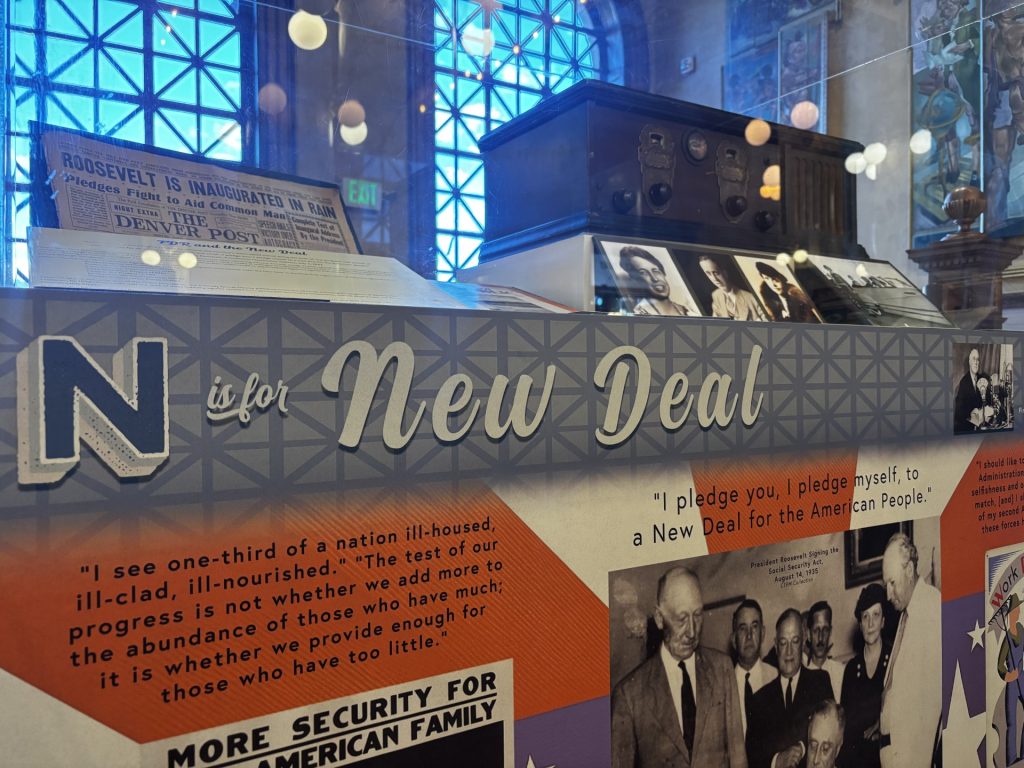
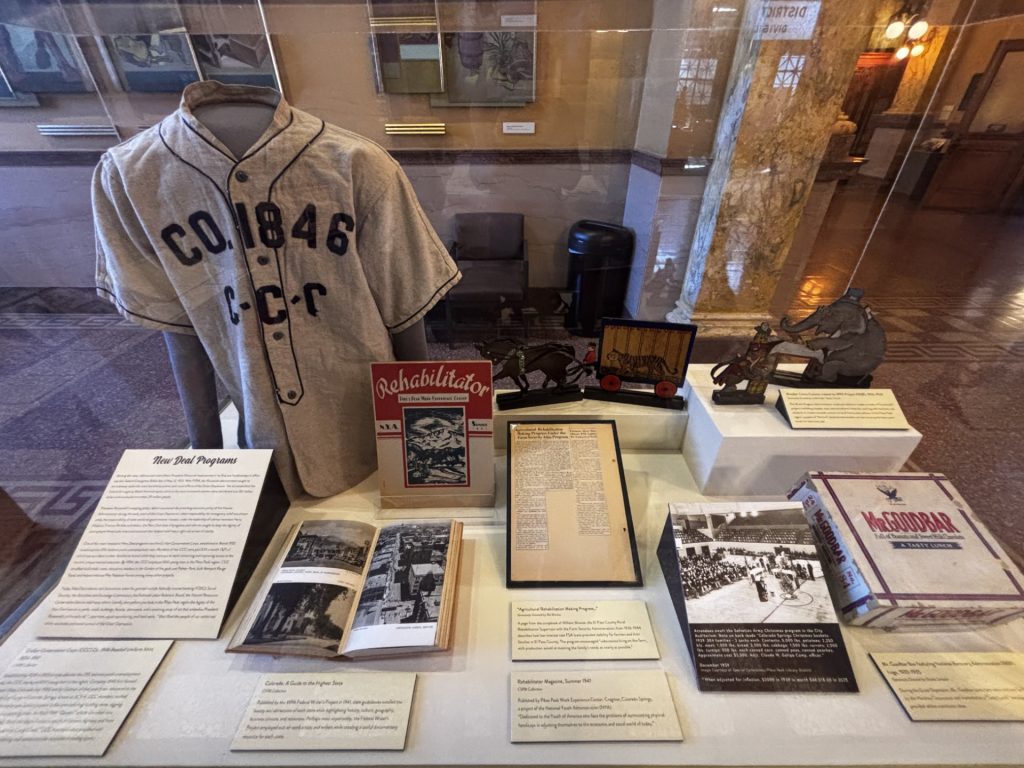
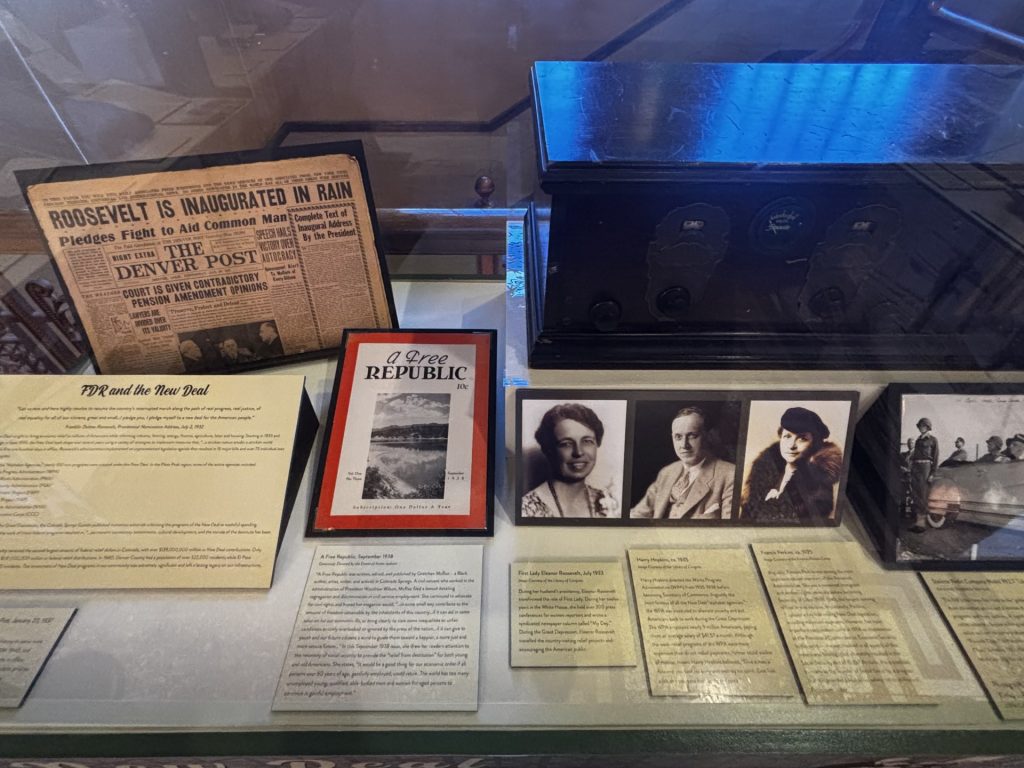
In partnership with the New Deal for the New Deal Committee in the Pikes Peak region, and extensive support from local historian and artist Pat Musick, the CSPM is proud to announce the latest Story of Us unit, N = New Deal which launched Saturday, October 6. Additionally, the CSPM exhibits team developed a three-case exhibit on the “Great Depression”, the “FDR Administration,” and the “Legacy of the New Deal” which is open on the 3rd Floor South Lobby. This fascinating story is essential to understanding the rich history of the nation and our region. The centerpiece of the exhibit is the case focused on how the administration of President Franklin Delano Roosevelt took action to buoy American families and workers during an unprecedented economic disaster.
“Let us now and here highly resolve to resume the country’s interrupted march along the path of real progress, real justice, of real equality for all of our citizens, great and small…I pledge you; I pledge myself to a new deal for the American people.”
Franklin Delano Roosevelt, Presidential Nomination Address, July 2, 1932.
Roosevelt’s New Deal sought to bring economic relief to millions of Americans while reforming industry, farming, energy, finance, agriculture, labor and housing. Starting in 1933 and continuing through at least 1939, the New Deal took shape over a number of years using a variety of strategies to implement measures that, “…a stricken nation amidst a stricken world require.” During his first one hundred days in office, Roosevelt’s administration implemented an unprecedented legislative agenda that resulted in 15 major bills and over 75 individual laws passed through Congress.
Often referred to as the “Alphabet Agencies,” nearly 100 new programs were created under the New Deal. In the Pikes Peak region, some of the active agencies included:
Works Progress Administration (WPA)
Public Works Administration (PWA)
Farm Security Administration (FSA)
Federal Writers’ Project (FWP)
Federal Art Project (FAP)
National Youth Administration (NYA)
Civilian Conservation Corps (CCC)
Interestingly, in the early days of the Great Depression, the Colorado Springs Gazette published numerous editorials criticizing the programs of the New Deal as wasteful spending. However, by 1936, they noted that the work of these federal programs resulted in, “…permanent community betterments, cultural development, and the morale of the destitute has been immeasurably lifted.”
It should also be noted that El Paso County received the second largest amount of federal relief dollars in Colorado, with over $139,000,000 million in New Deal contributions. Only Denver County received more, with over $141,000,000 million in federal relief distributions. In 1940, Denver County had a population of over 322,000 residents while El Paso County’s population was just shy of 55,000 residents. The investment of New Deal programs in our community was extremely significant and left a lasting legacy on our infrastructure, parks, forests, and public amenities.
The October 1929 Stock Market Crash that caused the Great Depression was not a singular event, but a series of market losses. “Black Monday,” preceded “Black Tuesday,” and by mid-November the United States Stock Market had lost over half of its value. The continued economic collapse destroyed the livelihoods and fortunes of many Americans, from speculative investors to rural mortgage holders. Across the nation thousands of banks closed, and in an era without federally insured deposit protection, families lost homes, farms, businesses, and their life savings. In Colorado Springs, the locally owned State Savings and Loan offered customers only 40 cents on every dollar in their accounts or applied the total amount of a customer’s loss as a credit to their mortgage debt.
Additionally, within the next decade, the Pikes Peak region experienced numerous natural disasters including floods, ongoing drought, and grasshopper plagues. In January 1931, 500 unemployed men marched to Colorado Springs City Hall demanding relief. By 1932 it was reported that ranchers in eastern El Paso County were watching their livestock starve with no grain to feed them. Joyce Marlow, who grew up in Colorado Springs during the Great Depression recalled a man knocking on their back door to ask for a sandwich. “But it wasn’t unusual for the time, because I think that happened quite often, that people were just plain hungry without work.”
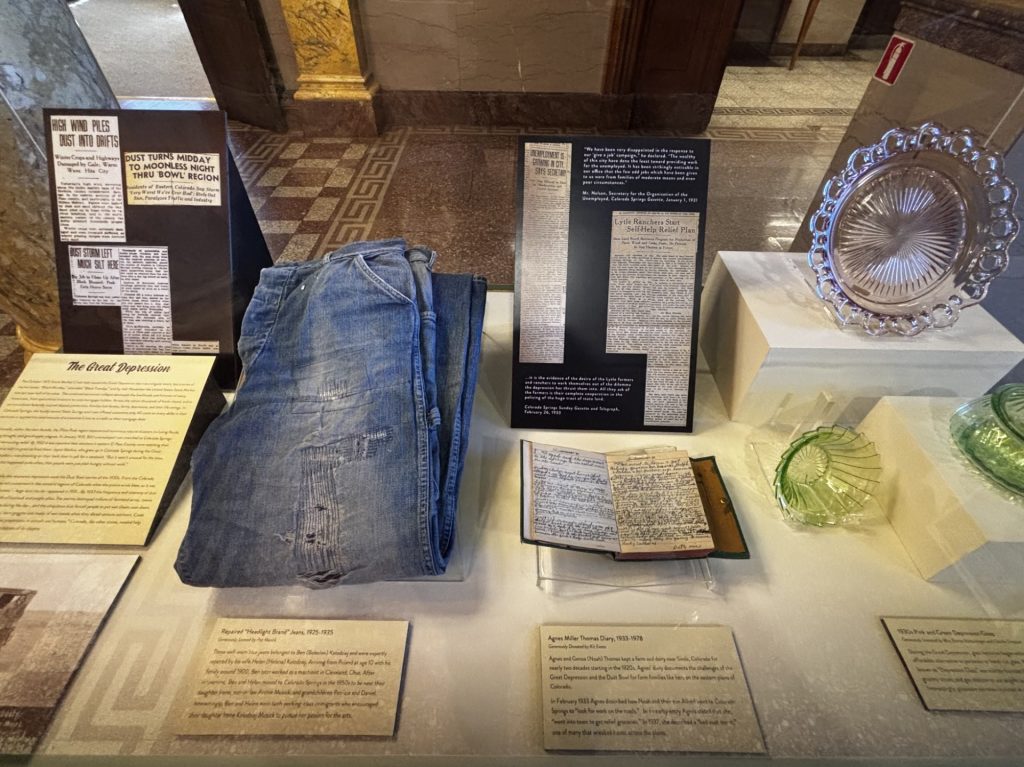
Exacerbating an already dire economic depression were the Dust Bowl storms of the 1930s. From the Colorado Encyclopedia: “Dust was not uncommon in the semiarid regions of Colorado when the prairie winds blew, so it was no surprise when a few “dusters”—large dust clouds—appeared in 1931… By 1933 the frequency and intensity of dust storms endangered the health of livestock and people alike…The storms destroyed millions of farmland acres…towns had to turn on their streetlights during the day… and the ubiquitous dust forced people to put wet sheets over doors and windows. Colorado’s farmers…wore goggles and masks of wet towels when they dared venture outdoors. Cases of dust pneumonia reached epidemic proportions in animals and humans.” Colorado, like other states, needed help addressing the increasing poverty and distress of its citizens.
Among the many reforms and relief efforts President Roosevelt implemented in his first one hundred days in office was the Federal Emergency Relief Act of May 12, 1933. With FERA, the Roosevelt administration sought to immediately tackle the most harmful economic and social effects of the Great Depression. The act established the Federal Emergency Relief Administration, which in the next nineteenth months alone distributed over $3.1 billion dollars and employed more than 20 million people.
President Roosevelt’s sweeping policy reform countered the prevailing economic policy of the Hoover Administration during the early years of the Great Depression, when responsibility for emergency relief was almost solely the responsibility of state and local governments. Instead, under the leadership of cabinet members Harry Hopkins, Frances Perkins and others, the New Deal slate of programs and reforms sought to keep the dignity of unemployed Americans intact and asserted that federal relief was a right not an act of charity.
One of the most innovative New Deal programs was the Civilian Conservation Corps, established in March 1933 to address the 25% national youth unemployment rate. Members of the CCC were paid $30 a month ($25 of which was sent back to their families at home) while they were put to work conserving and improving access to the nation’s unique natural resources. By 1934, the CCC employed 600 young men in the Pikes Peak region. CCC enrollees built trails, roads, and picnic shelters in the Garden of the gods and Palmer Park, built Rampart Range road, and helped reforest Pike National Forest among many other projects.
Today, New Deal reforms and innovations taken for granted include federally-insured banking (FDIC), Social Security, the Securities and Exchange Commission, the National Labor Relations Board, the Natural Resources Conservation Service and many others. Locally, everywhere you look in the Pikes Peak region the legacy of the New Deal lives on in parks, roads, buildings, forests, stonework, and a stunning array of art that embodies President Roosevelt’s philosophy of, “…optimism, equal opportunity, and hard work…” that lifted the people of our nation out of the economic and social turmoil of the Great Depression.

Leah Davis Witherow, Curator of History
719.385.5649 | Leah.Witherow@coloradosprings.gov