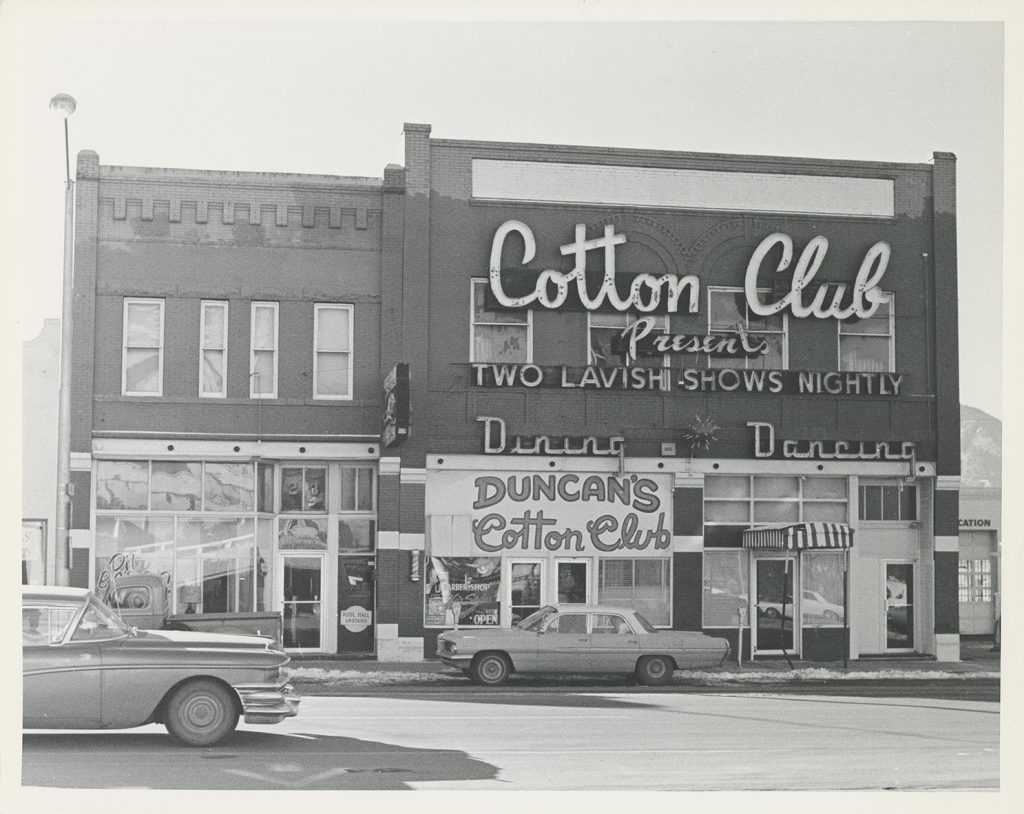
Duncan’s Cotton Club on East Colorado Avenue, ca. 1970.
August is Black Business Month, a great time to highlight stories of historic Black businesses in the Pikes Peak region. All of the stories listed below are represented by collections in the CSPM Archives, or in the Museum’s exhibits. Visit the museum, and the archives, to learn more!
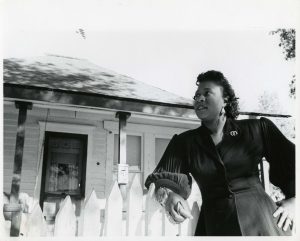
Fannie Mae Duncan, ca. 1955, Photograph by Lew Tilley.
Fannie Mae Duncan's personal stationary.
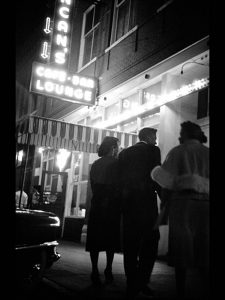
Fannie Mae Duncan and guests in front of Duncan's Cotton Club, ca. 1955, Photograph by Lew Tilley.
Fannie Mae Duncan, The Cotton Club
In 1944, at age 26, Fannie Mae Duncan obtained a business license to operate the downtown USO café with her husband Ed. Four years later, the two purchased the building at 25 W. Colorado Avenue and started Duncan’s Café and Bar downstairs. Fannie Mae later opened the renowned Cotton Club on the top floor of the building.
Despite the 1935 Colorado Civil Rights Act banning discrimination based on race, many restaurants and bars in Colorado Springs refused to serve Black patrons. Duncan stood up to Police Chief “Dad” Bruce when he told her not to “run” an integrated club. Soon, word spread that “everybody was welcome” at the Cotton Club. The nightclub featured music legends such as Louis Armstrong, Duke Ellington, and Etta James. Although Ed Duncan died in 1955, Fannie Mae operated the Cotton Club until 1975, when the building was razed during a downtown urban renewal project.
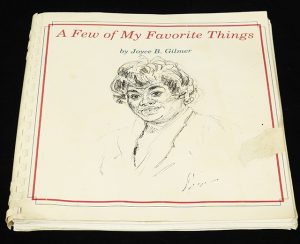
"A Few of My Favorite Things" by Joyce Gilmer, Cookbook.
Photograph of Karen and Joyce Gilmer, Courtesy of Jane McBee, 1993, CSPM Collections.
An advertisement placed in the 1978 Colorado Springs NAACP Chapter annual banquet program.
Joyce Gilmer, Joyce Realty
In 1971, shortly after moving to Colorado Springs with her servicemember husband, Joyce Gilmer and her husband divorced and Joyce became a single mother. She loved the area and decided to put down roots and raise her three children here. Five years later, she opened her own company, Joyce Realty, and became the first Black female real estate broker in Colorado Springs.
Remarkably, as a single working mother, Joyce Gilmer graduated from UCCS with a Business Degree at the age of 47 in 1983. Her gold UCCS graduation gown – made especially for her – is on exhibit in the Any Place That is North and West gallery.
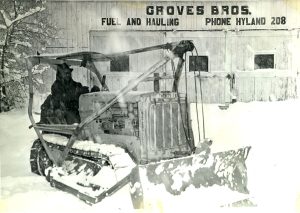
A Groves Brothers truck in front of the family's business in Manitou Springs, 1944.
The Groves Family, Groves Brothers Fuel and Hauling
In 1890, John and Louisa Groves, both formerly enslaved persons, moved their family to Manitou Springs, Colorado, from their farm in rural Missouri. They came to Colorado after John was diagnosed with Tuberculosis. Entrepreneurial by nature, the Groves raised hogs and cut lumber from nearby forests which they sold as fuel to local residents.
After John Groves’ death, sons Harry Augustus and his younger brother Theodore operated Groves Brothers Fuel and Hauling Company. The business eventually oversaw large-scale construction contracts and the brothers prospered. In 1961, retired contractor Theodore Groves became the first African American elected to the Manitou Springs City Council
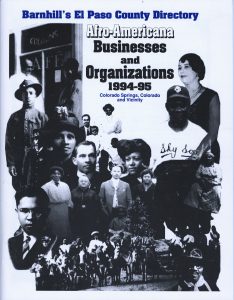
Carrie Barnhill's 1994-1995 directory of African American businesses in the Pikes Peak region.
Carrie Barnhill, Barnhill Enterprises
In 1986, Carrie Barnhill formed Barnhill Enterprises with the goal of publishing a directory dedicated to minority-owned businesses and entrepreneurs of the Pikes Peak region. In addition to highlighting Black-owned businesses, Barnhill’s directories provided an affordable advertising platform, a helpful list of African American organizations, churches, and social groups for newcomers to the region. Additionally, the directories created a reference document for government agencies to encourage African American businesses and entrepreneurs to place bids for city, state, county, and federally funded projects.
Perhaps most importantly, Carrie Barnhill intended for Barnhill’s El Paso County Directory of Afro-Americana Businesses and Organizations to serve as a lasting historical record of the many African American businesses, churches, and civic organizations in the region. In a 2021 interview Barnhill stated, “If you don’t know where you came from, you don’t know where you are going.”
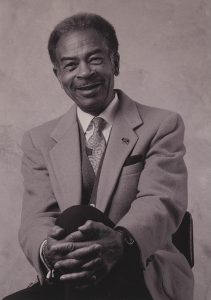
Mayor Leon Young, ca. 1997.
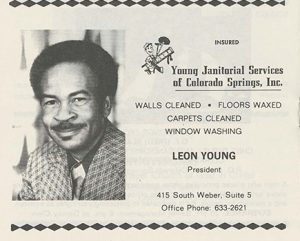
Advertisement for Young Janitorial Services from the 1978 Colorado Springs NAACP annual banquet program.
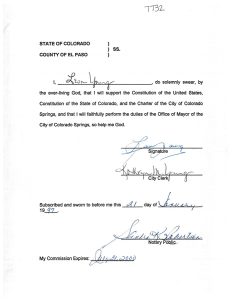
Oath of Service signed by Leon Young to become Mayor of Colorado Springs.
Leon Young, Young Janitorial
A veteran of both WWII and the Korean Conflict, Leon Young founded Young Janitorial Service in 1955, a business which went on to become one of the most successful Black-owned enterprises in Colorado.
As a respected business owner and community leader, Young was encouraged to run for City Council in 1973. Among the many issues he championed were improved funding for social services, civility among elected officials, and equal opportunity in the municipal workforce. He spearheaded several neighborhood improvement projects, including Shook’s Run, Hillside, and Old Colorado City.
Young was elected Vice Mayor in 1981 and was the first Black Mayor of Colorado Springs in 1997 when Robert “Bob” Isaac retired. That same year, Young closed his business but his office door always remained open for residents who wanted to voice their concerns.
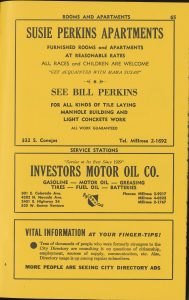
Advertisement for Susie Perkins Apartments, from the Colorado Springs City Directory, 1952
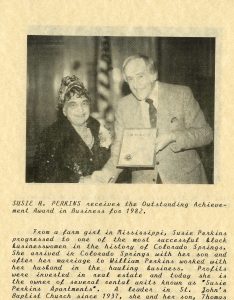
In 1982, NHACS awarded Susie Perkins with the Outstanding Achievement Award in Business.
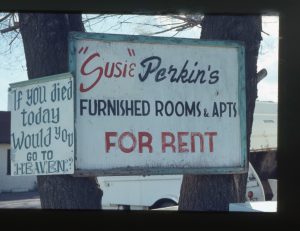
Sign for Susie Perkins Apartments in Colorado Springs, ca. 1970
Susie Perkins, Susie Perkins Apartments
“Mama” Susie Perkins was a trailblazing entrepreneur who fought discrimination by buying and renovating real estate. She eventually owned over 100 properties, renting them out to single mothers, mixed-race couples, and Black Fort Carson soldiers and their families. In other words, all the people other landlords turned away.
A true entrepreneur, she invested in her first properties with proceeds from a trash hauling business she ran for 12 years. By the time she sold the business, Perkins had 7 trucks and 7 crews. Additionally Susie, and her husband ”Daddy Bill” briefly ran “”Bill and Susie’s Cafe” on Colorado Avenue. Perkins shared her success with the community; she a was a generous donor to schools and charities of the Pikes Peak region.
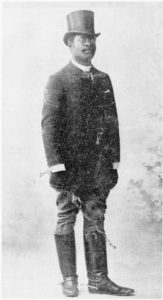
Charles Collins, ca. 1890.
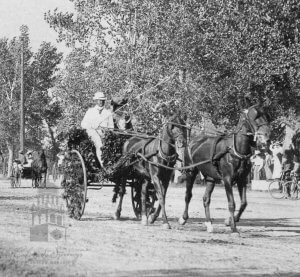
Charles and Evline Collins in the 1899 Colorado Springs Flower Parade.
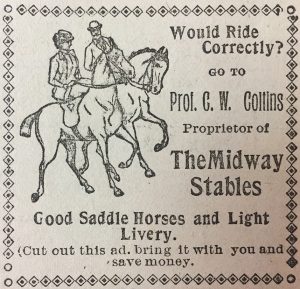
An 1898 Colorado Springs Gazette Advertisement for Charles W Collins' Riding School.
Charles Collins, Collins Riding School
Charles Collins came to Colorado Springs from Missouri in 1882 at age 27. He initially worked as a waiter at the Antlers Hotel, the largest regional employer of African American men in the 1880s. However, in 1888 Collins began offering riding instruction at the city’s Athletic Grounds and was soon recognized by locals and visitors alike as the “Riding Master” of Colorado Springs.
By March of 1890, his school became so successful that he quit his position as headwaiter at the Antlers Hotel in order to devote his full attention to his business. Collins was an astute businessman who catered to the elite and the aspiring middle classes who wanted their daughters and sons to be taught proper equestrian skills. In addition to his riding school, Collins owned a 160 acre ranch east of town where he stabled his horses. Collins and his wife Evline operated a boarding house at 423 East Huerfano Avenue (now Colorado Avenue) known as the “Wisconsin House
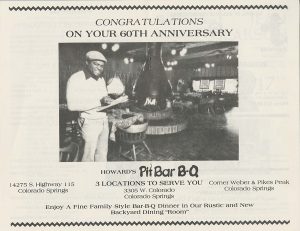
An advertisement for Howard's Pit Bar B-Q is from the 1978 Colorado Springs NAACP annual banquet program.
Howard Smith, Howard's BBQ Pit
A soldier stationed at Fort Carson, Howard Smith first starting selling barbeque at a road-side stand on the west-side of Colorado Springs. Soon thereafter, he opened Chef’s Table which in 1972 was renamed “Howard’s Pit Bar B-Q.”
Smith’s restaurant business grew with the help of family, including his three sons who worked in the mornings before heading to school. Smith moved from his West Colorado Avenue location twice after being forced out by a fast food restaurant and a grocery store chain. In 1997 the restaurant moved to 114 South Sierra Madre.
Over four decades, Smith’s food was celebrated by local residents and well known visitors including Ray Charles, B.B. King, and the U.S. Women’s Volleyball team. Howard Smith passed away in 2024. The family run “Lil’ Howard’s BBQ” continues to serve delicious food that once earned him the title of “barbeque king.”