
On August 15, 1935, legendary humorist Will Rogers and famed aviator Wiley Post died in a plane crash near Point Barrow, Alaska. This shocking accident resulted in federal and state flags across the country being lowered to half-staff and 12,000 movie theater screens going dark for two minutes on August 22, 1935, as a silent tribute. Close friends late in their lives, both men hailed from Oklahoma and went on to become beloved cultural icons in Depression-era America.
Wiley Post was eulogized as the “greatest flier of all time,” and “the most advanced and courageous man aviation has thus brought forth,” by famed German aviator Ernst Udet. However, his path to aviation was circuitous at best. After dropping out of high school and a stint as a “roughneck” in Oklahoma oilfields, Post was arrested for armed robbery. In the mid-1920s Post joined a flying circus as a parachutist. He lost an eye in an earlier oil field accident, and the eventual payout paid for his fight training and the purchase of his own plane.

In 1928 Post became the personal pilot for oilman F.C. Hall and won the Chicago Men’s Air Derby in Hall’s Lockheed Vega named “Winnie Mae.” In 1931, Post broke the around-the-world speed record in the “Winnie Mae” alongside navigator Harold Gatty. This feat won him widespread international acclaim but not wealth. After buying the “Winnie Mae” from Hall, Post repeated the around-the-world flight in 1933, but this time solo. Flying without a navigator, Post took a risk to use new but untested technologies including a Sperry autopilot, an Army radio compass, and a Smith variable propeller. Despite poor weather, Post was successful and beat his own record by nearly a day.
Will Rogers was born on a large ranch in the Cherokee Nation. After dropping out of high school he first became famous on the vaudeville circuit as a trick roper in the early twentieth century. By the 1920s he began appearing in silent films and cemented his stardom as a folksy, witty, and insightful commentator in syndicated columns in the New York Times. According to the Will Rogers Memorial Museum, from his first newspaper article in 1916 until his last column in 1935, Rogers put “approximately two million words in print.” Famous for his sharp wit, Will Rogers once said, “My ancestors didn’t come over on the Mayflower, but they met the boat.”
A big fan of aviation, Will and Wiley became friends after Post’s 1931 record-breaking flight. When Post suggested a “flying holiday” an overworked and exhausted Rogers jumped at the chance to explore Alaska and Russia by plane. Unfortunately, Post’s plane for the trip was a composite of several types of aircraft and was “dangerously nose-heavy” according to experts. While taking off from a small lake near Point Barrow, Alaska, the engine sputtered, and the plane crashed, killing both pilot Post and passenger Rogers.
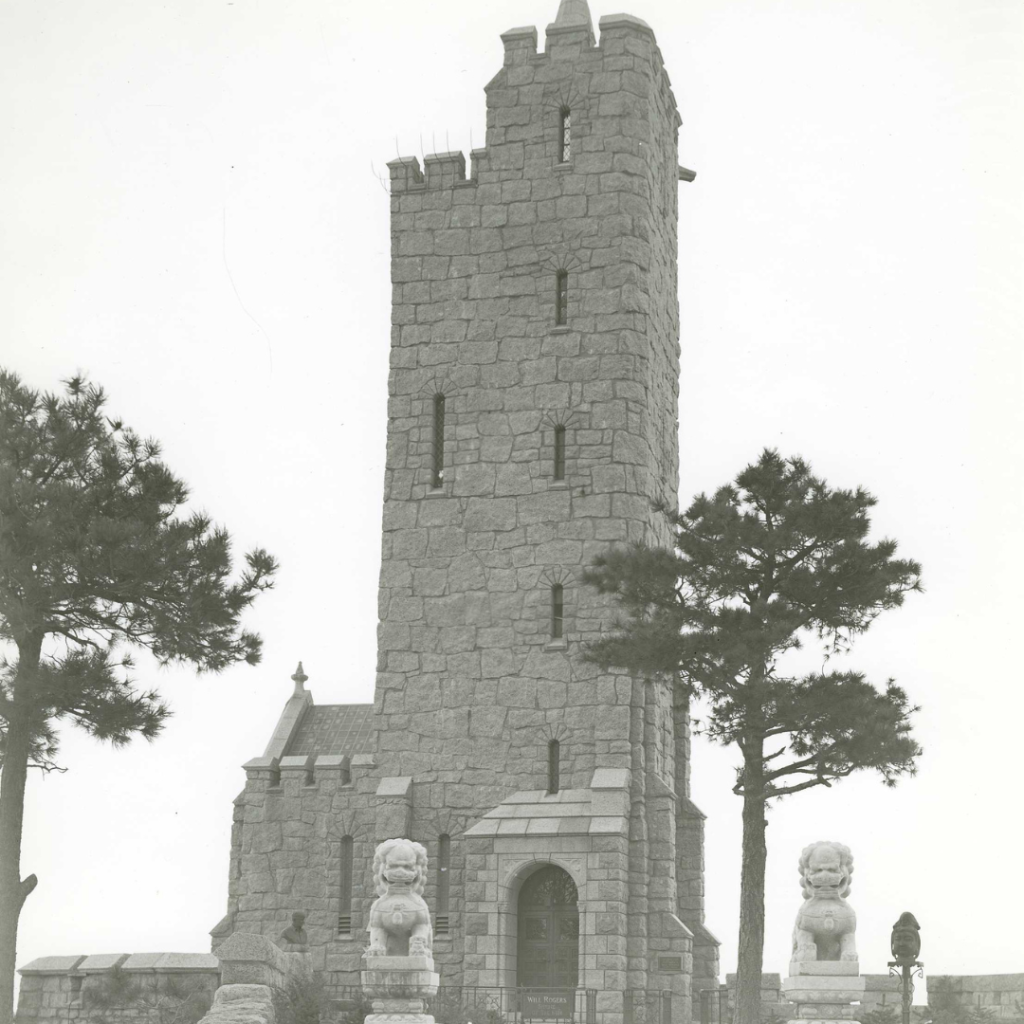
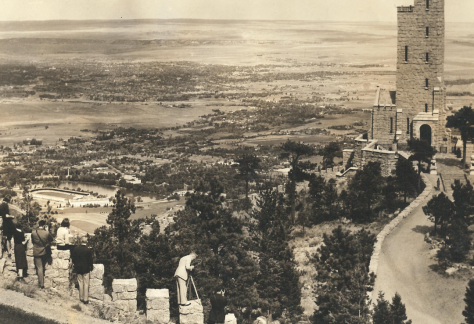
In Colorado Springs in 1935, work was already underway on the “Shrine of the Sun” when word of Rogers’ untimely death at age 55 reached Spencer and Julie Penrose. At its completion, the 114-foot-tall Shrine made from Cheyenne Mountain granite was named in tribute to Will Rogers.
Additionally, Wiley Post’s “Winnie Mae” airplane is among the most treasured objects in the collection of the Smithsonian’s National Air and Space Museum in Washington D.C
Learn More